
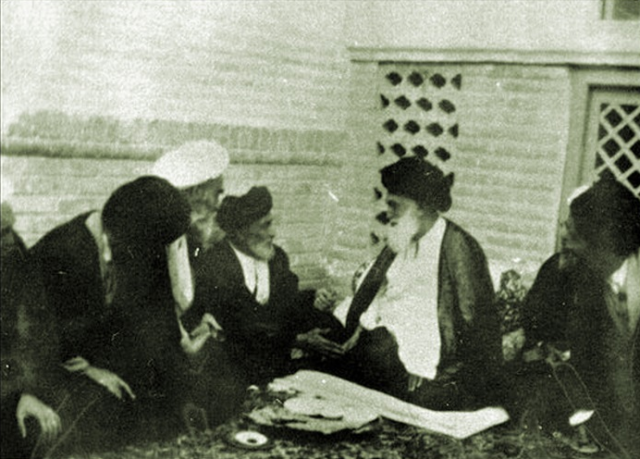

Interview on Burūjerdī, the Sole Marjaʿ al-Taqlīd of the Shia
Huccetullah Sözgen & Ozan Dur
1. To begin with, Huccet, could you introduce yourself?
I am originally from Midyat, and due to the region in which I grew up, I have been exposed to various languages and cultures. In fact, I can say that my mother tongue is Arabic and that I learned Turkish at school. I completed my undergraduate studies in Primary School Teaching in Istanbul, and I currently work as a primary school teacher within the Ministry of National Education.
2. Your thesis includes Persian, English, and Turkish sources. It seems you have been working on Iran for quite some time. What led you to specialize in Iran?
As can be inferred from the title of my thesis, its subject matter is not widely explored or debated in Turkey. Therefore, the scarcity of Turkish sources made it necessary for me to consult Persian and English materials. I hope that this thesis will pave the way for further research in this direction.
My academic and personal engagement with Iran goes back about eight years. I first endeavored to learn Persian, and later traveled to Iran to deepen my knowledge. If I were asked why I chose the Iranian cultural sphere, I would attribute it to the curiosity instilled in me by the region in which I was born and raised. Living among different cultures and languages made it easier for me to learn Persian. Once I learned the language, my interest in Iran grew even further, prompting me to work more seriously in this field.
3. Why did you feel the need to choose this topic? Could you explain its significance to readers?
Given my interest in history and religious education, choosing a topic in this direction was important in terms of productivity. During my readings, I came across the name Burūjerdī, who revitalized the Qom Seminary (ḥawza) and contributed significantly to its educational system. My research revealed that there was limited data on such an important figure, so I chose to focus on him. As I explored the topic further, I realized that my decision had indeed been the right one.
Burūjerdī was highly respected in the Shia world of his time, serving as the sole marjaʿ al-taqlīd whose rulings were followed by a majority of Shiites and to whom they entrusted their religious donations. Although not deeply involved in politics, neither was he fully isolated from it; rather, he shaped the clerical influence that eventually contributed to the revolutionary process in Iran. Burūjerdī represented a typical Shia clerical profile—unlike Khomeini, he lacked political ambition. This fundamental difference ultimately created tension between the two.
Our study demonstrates that interpreting the Iranian clerical profile solely through the lens of Khomeini—who can be considered a marginal figure—leads to an inaccurate understanding. Khomeini was an exception within the traditional Shia clerical establishment and did not embody its typical characteristics. Indeed, unlike Burūjerdī, Khomeini was not universally accepted as the sole religious authority even within his own country. Though he was the singular figure of political authority, he faced many rivals in the realm of religious authority. Therefore, it is incorrect to evaluate the Iranian clerical institution exclusively through Khomeini.
4. Burūjerdī was a Shia cleric. Some in Iran regard him as the “renewer (mujaddid) of the age.” Could you describe his activities in Qom? What accounts for his success?
The title mujaddid was given to Burūjerdī by his own students, largely due to his activities in Qom. Before his time, Shaykh ʿAbd al-Karīm Hāʾirī Yazdī—who had revived and reorganized the previously dispersed Qom Seminary—had been called the founder (mu’assis). To understand Burūjerdī’s contributions, it is useful to examine the historical context.
Under Yazdī, the Qom Seminary expanded, but after his death the administration was divided among three ayatollahs. Due to Reza Shah’s pressures, the seminary was on the verge of collapse—a period often referred to as “fetrat,” which lasted from 1937 to 1944. In 1944, Burūjerdī traveled to Tehran for a hernia treatment. Many prominent figures, including Muhammad Reza Shah, visited him, generating broad public attention. At that time, Khomeini made considerable efforts to persuade Burūjerdī to settle in Qom. Khomeini even stated, “Burūjerdī came to Qom 20 years late, yet he still managed to develop the seminary.” After attending his lectures, he also remarked, “Those who join his classes reach the level of ijtihād without even realizing it.”
Burūjerdī brought a more systematic method to religious education in Qom, especially in jurisprudence (fiqh) and hadith studies. He believed that Sunni jurisprudential and hadith methodologies were more coherent in certain respects compared to those of the Shia. Therefore, he advocated consulting Sunni sources when necessary. With this approach, he worked toward reducing sectarian tensions between Sunnism and Shiism. He studied both Shia and Sunni sources, which widened his perspective on the Muslim world and enabled him to introduce new educational methods.
He instituted an examination system to ensure academic continuity, awarding scholarships based on exam performance. This motivated students to exert greater effort. Furthermore, he allowed the study of foreign languages, opening the seminary to engagement with Western societies.
In terms of finance, Burūjerdī significantly strengthened the seminary. As the sole marjaʿ al-taqlīd, he attracted considerable donations to Qom. With these funds, he supported other seminaries, including the historic center of Najaf, and expanded his influence. He provided scholarships to students and ensured that all financial transactions were recorded, keeping the seminary’s finances under his personal supervision—though he did not use donations for personal expenses, as he came from a wealthy family.
In sum, Burūjerdī’s success can be attributed to his broad vision, impartial approach, and the fact that he directed the donations he received toward education—enhancing both his reputation and his following.
5. Could you elaborate on the relationship between Burūjerdī and Khomeini?
The relationship between Khomeini and Burūjerdī began when the latter came to Tehran for medical treatment. Khomeini worked to bolster Burūjerdī’s reputation and help him assume leadership of the Qom Seminary. It is even said that Khomeini sent around 400 telegrams to various figures to garner support. Interestingly, the Shah also worked to install Burūjerdī as the head of the Qom Seminary. Thus, both Khomeini and the Shah mobilized all available means to elevate Burūjerdī.
After Burūjerdī settled in Qom, Khomeini became his closest associate. When Burūjerdī departed for Mashhad on pilgrimage, he appointed Khomeini as his deputy during his absence. Even when press statements were required, Burūjerdī sent Khomeini as his spokesperson. Khomeini participated in meetings, and Burūjerdī valued his opinions. Their families even arranged marriages between their children.
This close relationship continued until the idea of establishing a consultative council for seminary governance emerged, which caused a rift between them. As Burūjerdī maintained a cautious stance toward the Shah and resisted Khomeini’s attempts to influence him politically, Khomeini refrained from openly opposing Burūjerdī due to his authority and instead chose silence. Until Burūjerdī’s death, Khomeini withdrew from public teaching and kept to his cell. When Burūjerdī passed away, many states declared mourning, yet Khomeini did not attend the funeral.
6. The doctrine of velāyat-i faqīh that sustains the authority of Iran’s Ayatollah-led system created a distinct global perception of Iran. Clerics had never played such an overtly political role in Iranian history. Although they criticized the Shah—as in the Tobacco Protest—they did not seek to govern the state. Today we see an active and revolutionary clerical profile, largely shaped by Khomeini. What was the situation like during Burūjerdī’s time?
Historically, until Khomeini, the Shia clerical class did not pursue political power or governance. On the contrary, they tended to maintain a cooperative or reconciliatory attitude toward the state. The clearest example is the reaction of Shaykh ʿAbd al-Karīm Hāʾirī Yazdī, founder of the Qom Seminary, who remained silent when one of his assistants was publicly flogged by Reza Shah in Qom.
Looking further back, Burūjerdī’s ancestors—known as Majlisī-yi Awwal and Majlisī-yi Duvvom—worked closely with the state. Majlisī-yi Duvvom even structured Shia religious instruction around absolute obedience to the ruler, asserting that disobedience to the ruler equated to disobedience to God.
Even in the Tobacco Protest led by Hasan Shirazī—another sole marjaʿ al-taqlīd—there was no ambition to seize political control. Once the tobacco concession was revoked, the movement dissolved.
Similarly, Burūjerdī, despite his authority, was not someone who sought to establish an Islamic state. His view was that everyone should focus on their own responsibilities: religious scholars should fulfill their religious duties and avoid becoming entangled in politics. In 1949, he gathered numerous scholars and forbade them from political involvement. This should not be misunderstood as complete political withdrawal; rather, Burūjerdī believed in intervening when necessary but not in positioning the clergy as political rulers.
During the Mossadegh crisis, for example, Burūjerdī maintained his silence, indirectly enabling the Shah to consolidate power. When asked why he did not oppose the Shah, he replied, “I once witnessed the destruction of the Qom Seminary. I cannot witness its destruction again.” This clearly indicates that he cooperated with the state to protect the seminary and preferred to live as a religious scholar rather than a political actor.
7. Outside Iran, there are other Shia seminaries—most notably in Iraq. Today, Iran has significant policies directed toward Iraq, and some important Shia figures are buried there. Why does Iran seek to establish a seminary in Qom that can rival Iraq’s Shia centers? How do Persian-speaking and Arabic-speaking Shia scholars perceive one another? What insights did you gain in your thesis on Iranian and Iraqi Shiism?
While working on my thesis, I was particularly surprised to discover that Reza Shah supported the re-establishment of the Qom Seminary. In fact, Reza Shah initially aimed to create a seminary in Iran that could rival those outside the country, such as Najaf. He preferred that Iranian students receive religious education within their own linguistic and cultural context, rather than traveling to Iraq. This aligns with his nationalist ideology and his attempt to reinforce an Iran-centered religious elite.
Additionally, in the early years of his rule, Reza Shah needed the support of the clergy, so he sought to present himself as not hostile to religion. Once he consolidated power, however, he moved to undermine clerical influence, and by the time of Muhammad Reza Shah, many seminaries in Iran were facing extinction. The arrival of Burūjerdī in Qom reversed this trajectory, and the Qom Seminary eventually grew strong enough to weaken even the thousand-year-old Najaf center.
The strengthening of Qom with state support was largely a nationalist project aimed at creating a religious center independent of Arab influence. As for conflict between Arab and Persian clerics, I cannot definitively confirm such a generalization. Before Qom rose to prominence, many Iranian scholars had been trained in Najaf, and even religious qualification often depended on study there. Najaf’s importance was reinforced by the presence of the tombs of revered Shia Imams. Yet the shrines of Lady Maʿsuma in Qom and Imam Reza in Mashhad also hold significance for both Iranian and Arab Shia communities.
8. What is the current significance of Qom in Islamic education? During Reza Shah’s rule, the state attempted to take control of religious education. Persian was purified of Arabic expressions and replaced with Pahlavi terms. How did the state intervene in the religious sphere? What is Qom’s role today?
As explained earlier, Reza Shah’s aim in promoting the Qom Seminary was to ensure that Shia students remained in Iran rather than traveling to Iraq and being exposed to Arab culture. He wanted them to receive education in Persian and within a Persian cultural framework, which would perpetuate nationalist sentiment. As part of his modernization program, he intervened heavily in both religion and language. He even established a faculty within the university to train preachers.
He also weakened the authority of religious courts, thereby reducing the influence of the clergy, which directly caused seminaries to lose students. Numerous other interventions could be listed, but essentially, Reza Shah instrumentalized religion and religious figures for his ideological objectives.
Today, Qom is the most authoritative center of religious education in Iran. Other seminaries operate under its influence. Although the Qom Seminary was on the brink of collapse a century ago, it is now one of the leading centers of Shia learning worldwide. Many figures who played major roles in the Iranian Revolution were trained there, as are many influential contemporary scholars.
Importantly, the Qom Seminary is not a state institution and does not operate on an official state budget. Clerics believe that dependence on the state would diminish its prestige and autonomy. Therefore, it functions through an internally governed system.
9. Could you discuss Burūjerdī’s efforts regarding the recognition of Shiism as a legitimate school of thought (madhhab) and their impact on today’s Islamic world?
Efforts toward rapprochement (taqrīb) between Sunni and Shia Muslims have long been discussed as a way to reduce sectarian strife. Prior to Burūjerdī, many attempted such initiatives, but none achieved substantial results, largely because the Shia side did not lend full support.
Burūjerdī, however, used his authority to advance these efforts. His representative in Egypt, Qummī, established the Dār al-Taqrīb in Cairo in 1947. Through Burūjerdī’s sponsorship and sustained efforts, Grand Shaykh of al-Azhar Maḥmūd Shaltūt issued a landmark fatwa in 1959 recognizing Shiism as a legitimate Islamic school. The fatwa stated that following Shia jurisprudence was permissible. This development was revolutionary. Shia texts were subsequently printed in Egypt, and courses on Shiism began to be offered at al-Azhar University. Shaykh Shaltūt acknowledged Burūjerdī’s pivotal role in shaping his views.
This fatwa offered a historic opportunity to resolve Sunni-Shia tensions. However, the deaths of both Burūjerdī and Shaltūt soon afterward stalled the initiative.
Although it had positive effects on the Islamic world, Iran’s later establishment of a similar institution in Tehran—and its use for propaganda—cast doubt on the sincerity of the effort. Moreover, Iran’s actions in Syria during and after the civil war significantly damaged Sunni perceptions of Shiism. The harsh policies adopted by Iran toward Sunni populations have reinforced skepticism about the possibility of Sunni-Shia rapprochement.
10. Burūjerdī introduced two innovations that were unusual for seminaries of his time: the inclusion of philosophy and foreign language study (particularly English). Could you elaborate on this?
At the beginning of Burūjerdī’s tenure in Qom, there was strong demand for philosophical instruction. However, the Mashhad Seminary, influenced by the Maktab-i Tafkīk, opposed these lessons; similar pressure came from Najaf. Unfortunately, this led to the termination of ʿAllāmah Ṭabāṭabāʾī’s highly attended philosophy courses. Burūjerdī even stopped granting scholarships to students studying philosophy, arguing that donors contributed funds for the study of jurisprudence and hadith, and that using such funds for philosophy would damage the seminary’s reputation. Montazeri later commented that Burūjerdī made this decision under intense pressure.
Yet it should also be noted that Burūjerdī himself had studied philosophy in his youth. He believed that philosophical study should not be open to the general student population; it should be reserved for advanced students and teachers. In his view, those whose theological beliefs were not yet firmly established might be adversely affected by philosophy.
Before Burūjerdī, those who studied Western languages faced social stigma and had to learn them secretly. Burūjerdī revolutionized this atmosphere by permitting foreign language study. He even allowed the reading of newspapers, provided they did not contain obscene content. Breaking with prior attitudes, he encouraged those who learned foreign languages by appointing them as his representatives abroad to protect Shia communities and engage in outreach. This was a significant undertaking, and he personally funded these activities. As a result, he had numerous representatives and offices in different countries.
Huccetullah Sözgen & Ozan Dur

Yorumlar
Yorum Yaz