
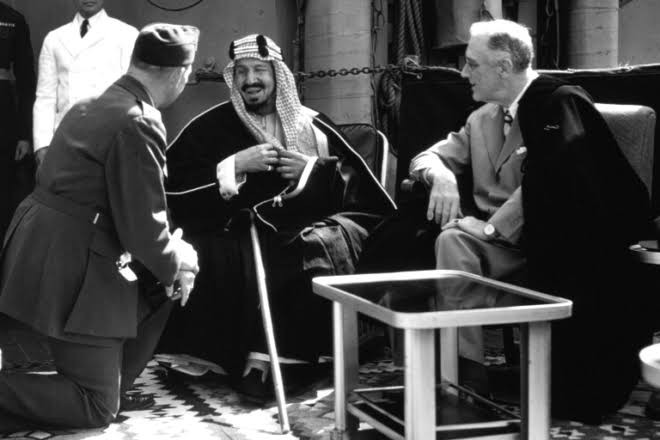

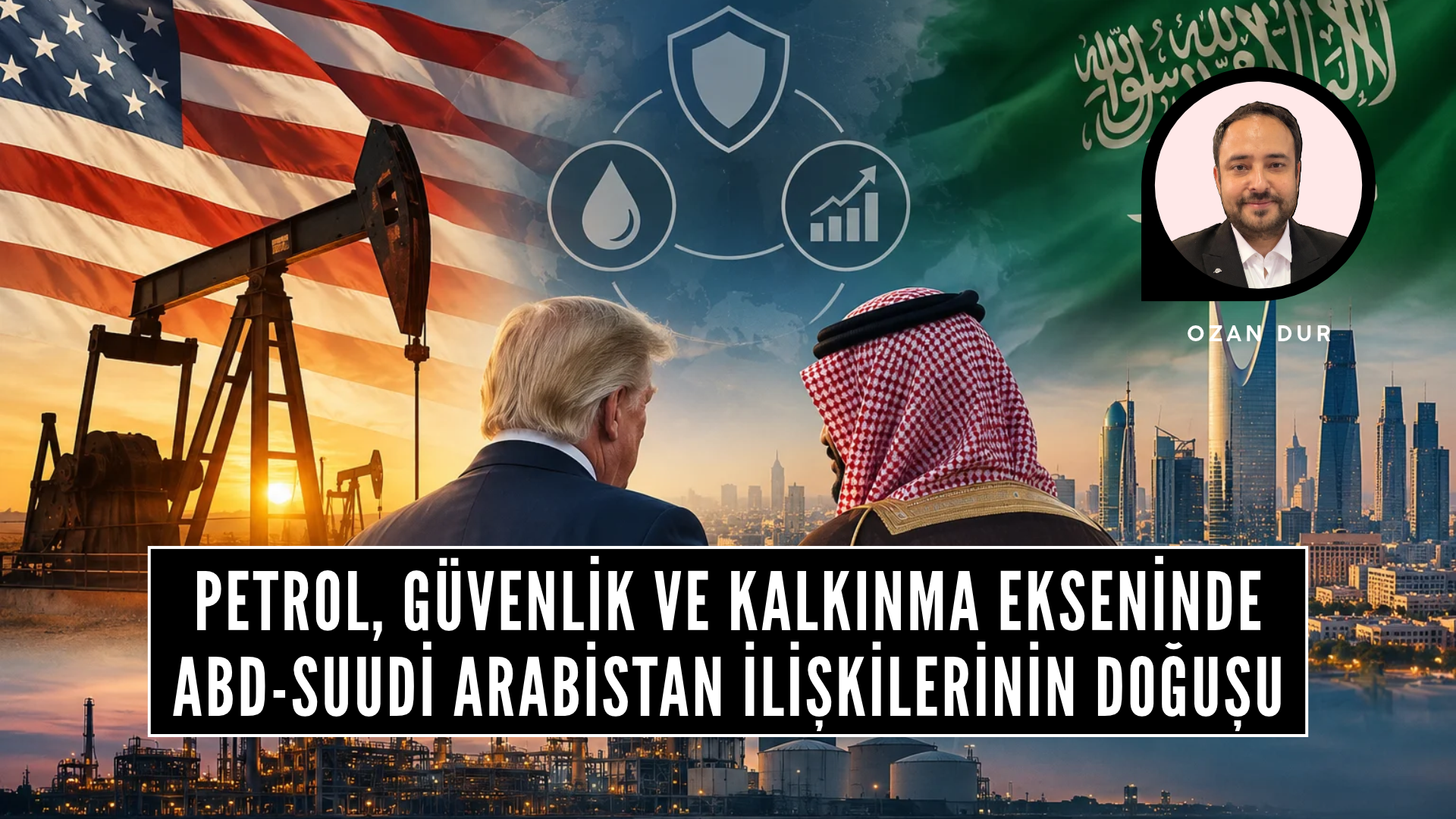
This article examines the early development of U.S.–Saudi relations, highlighting the central roles of oil, security, economic cooperation, and geopolitical interests. It traces the relationship from the discovery of Saudi oil and the rise of ARAMCO to the historic 1945 meeting between President Franklin D. Roosevelt and King Abdulaziz Ibn Saud. The article also explores American efforts to counter British influence, Saudi Arabia’s integration into the international system, and the Palestinian question as a significant source of disagreement between the two countries.
Early U.S.–Saudi Relations
Despite their many ideological differences, the United States and Saudi Arabia have maintained close relations for many years. While the United States was a developed and industrialized country, Saudi Arabia was still in the process of establishing a new kingdom. The Saudis succeeded in founding their kingdom after many years of struggle to secure territorial sovereignty. Whereas the United States was founded upon secular and democratic values, Saudi Arabia possessed a strict religious character. The energy sector was one of the principal factors that brought these two countries together. In exchange for access to its vast oil reserves, Saudi Arabia began to receive security assistance.
Oil, however, was not the sole basis of the relationship between the two countries. There was also a desire to counterbalance British influence in the region, while the Saudi state’s financial needs played an important role as well. The convergence of all these factors led the two countries to develop closer ties. Thus, U.S.–Saudi relations did not emerge solely on the basis of oil; rather, they developed through the combination of Saudi Arabia’s financial and security needs, the United States’ desire to gain access to energy resources, the attempt to balance British influence, and the strategic circumstances created by the Second World War.
Among the issues that most disturbed the countries of the Middle East was the presence of colonial powers. Britain and France, as colonial states, had caused considerable hardship for the countries of the region. One major factor behind Saudi Arabia’s desire to cooperate with the United States was the latter’s lack of a colonial history in the Middle East. Moreover, American companies operated relatively independently of the U.S. government. This could enable the Saudis to remain free from direct American political pressure. Ibn Saud also believed that the American economy was stronger than the British economy. In addition, Britain maintained close relations with the Hashemites, which caused further concern among the Saudis.
The United States’ initial interest in the region began in the nineteenth century. During this period, the United States was interested in overseas trade and sought to expand its engagement with the wider world. Although it was initially less influential than the colonial powers, periods would eventually emerge in which American influence increased considerably. Britain displayed the greatest interest in the Persian Gulf, primarily because of the Gulf’s importance to the security of the route to India.
Oil was first discovered in the Middle East in Iran in 1908. Following this discovery, oil was also found in Iraq, Bahrain, Kuwait, and other Gulf countries, increasing American interest in the region. During this period, Saudi Arabia was still in the process of state formation. Since the eighteenth century, the Saudis had established two states, both of which had eventually collapsed. They succeeded, however, in their third attempt. While the Bedouins provided the military power, Wahhabism constituted the religious foundation of the emerging state. Like other regional actors, the Saudis also benefited from the power vacuum created by the First World War.
The Kingdom of Hejaz and Nejd was proclaimed in 1926. Initially, the United States did not establish a diplomatic mission there, as it did not demonstrate a high-level interest in the newly founded country. American officials also took the financial cost of maintaining a diplomatic mission into consideration. After 1926, however, the Saudi state began to receive recognition from other countries and gradually achieved greater stability. Consequently, the United States formally recognized the Kingdom of Hejaz and Nejd on 1 March 1931. Before this date, an oil exploration concession had already been granted to an American company, although the United States had not yet shown immediate political interest in Saudi Arabia. Prior to the discovery of oil, the revenues generated from the Hajj constituted Saudi Arabia’s most important source of income.
In 1933, the Standard Oil Company of California (SOCAL) concluded an agreement with Saudi Arabia regarding oil exploration. At the time, the United States had no diplomatic mission in the kingdom. The discovery of oil in the Gulf countries strengthened the possibility that oil might also be found in Saudi Arabia. Although the hopes of the oil prospectors occasionally diminished, they continued their exploration activities. In 1938, oil was finally discovered at Dammam Well No. 7. On 1 May 1939, Ibn Saud attended a ceremony marking the connection of the oil field to the terminal at Ras Tanura. This development paved the way for oil exports, and production began at approximately four thousand barrels per day.
The true scale of Saudi Arabia’s oil reserves became apparent over time. The oil agreement signed by Saudi Arabia was not initially concluded with the U.S. government but with an American company. Nevertheless, the United States would gradually become directly involved in the issue because the fields in which oil could be used were becoming increasingly evident. Oil had become indispensable for land vehicles, naval forces, and industrial production. Energy geopolitics was thus added to existing theories of land and maritime geopolitics and dominance. Any state aspiring to become a great power had to exercise control over energy resources. If the United States sought to replace Britain and France as the dominant external power, it also needed to secure access to and influence over regional energy resources. Furthermore, it had to protect the investments of American companies.
Texaco also entered the Saudi oil sector. In 1944, the oil company was renamed the Arabian American Oil Company, commonly known as ARAMCO. In later years, other American companies, including Exxon and Mobil, also entered the Saudi oil industry. ARAMCO did not merely extract oil; it constructed roads, facilities, and ports while also providing technical services. These activities played a significant role in transforming the physical and economic landscape of Saudi Arabia. The country gradually began to move from a nomadic and agricultural economy towards industrialization.
The extraction and international export of Saudi oil coincided with the Second World War. Unlike several other countries in the Middle East, Saudi Arabia had not experienced a mandate administration. Nevertheless, oil production declined because of wartime difficulties, particularly problems related to transportation and supplies. In 1940, Saudi Arabia produced approximately 5.1 million barrels of oil annually. This figure fell to 4.3 million barrels in 1941. Following the end of the war, however, oil production increased dramatically. Production rose to 7.8 million barrels in 1944 and exceeded 21 million barrels in 1945.
The number of pilgrims travelling to Saudi Arabia also declined during the war because of factors such as the insecurity of transportation routes. Before the war, between 50,000 and 100,000 pilgrims arrived annually, but this number fell to between 20,000 and 30,000. This decline had a negative effect on the Saudi economy. The Saudi monetary system was also tied to the British pound sterling. In order to reduce this dependency, Saudi Arabia found itself with few alternatives other than developing closer relations with the United States. The military importance of oil also became much clearer during the war. This situation further increased American interest in Saudi Arabia.
The U.S. Congress passed the Lend-Lease Act in 1941. Washington’s decision was intended to provide assistance to countries fighting against the Axis powers. Saudi Arabia was not initially included in the programme. Throughout the war, however, the kingdom’s strategic importance became increasingly apparent. During this period, Saudi Arabia was experiencing severe financial difficulties. The United States did not want the investments of American oil companies to be damaged. It was also concerned about the expansion of British influence. Preventing the region from falling into instability became another fundamental objective. On 18 February 1943, President Franklin D. Roosevelt decided to extend Lend-Lease assistance to Saudi Arabia. Consequently, bilateral relations moved beyond oil-based ties between private companies and acquired the character of formal interstate relations. This represented an important step towards safeguarding American interests.
During Roosevelt’s presidency, a decision was made in 1943 to establish a permanent diplomatic mission in Saudi Arabia. The first American diplomatic mission was opened in Jeddah on 19 September 1943. A consulate was subsequently established in Dhahran in 1944. In 1948, the diplomatic mission in Jeddah was elevated to the status of an embassy.
U.S. President Franklin D. Roosevelt and King Abdulaziz Ibn Saud met face to face in 1945. Roosevelt personally desired this meeting, demonstrating the considerable importance Saudi Arabia had acquired in the eyes of the United States. The discussions addressed the oil industry, the question of Palestine, military cooperation, and the establishment of a military airbase in Dhahran. It was agreed that an airbase would be established in Dhahran and remain under American administration for five years. The United States also decided to provide Saudi Arabia with a significant quantity of military supplies, while the oil industry was to be further developed. The idea of providing security in exchange for oil emerged for the first time in this context.
Ibn Saud opposed the establishment of a separate Jewish state in Palestine. Roosevelt assured him that no decision concerning matters such as Jewish immigration would be made without consulting the Arabs. Roosevelt died shortly afterwards and was succeeded by Harry S. Truman, who would pursue a markedly different policy.
As the Second World War approached its conclusion, Saudi Arabia declared war on the Axis powers. This decision was significant in facilitating the country’s integration into the international system. Saudi Arabia declared war in March 1945 and participated in the San Francisco Conference. It also became one of the founding members of the United Nations. In this manner, it acquired the status of a recognized member of the international community. The United States played a major role in facilitating these developments, and Saudi Arabia’s relations with Washington had already begun to produce tangible results.
In 1946, the United States provided Saudi Arabia with a loan of 10 million dollars. In the same year, an additional loan of 2 million dollars was granted to enable the kingdom to purchase American weapons. Cooperation did not develop solely in the fields of defence and oil; the United States also contributed to agriculture, irrigation, transportation, and communications. An airline company was even established with American assistance. A railway between Dammam and Riyadh was also constructed with U.S. support, creating a direct connection between the oil-producing region and the political capital.
The question of Palestine constituted the most significant point of disagreement between the United States and Saudi Arabia. Ibn Saud sought to defend the rights of the Palestinians. He also opposed the transfer of the Jewish question, which he regarded as a Western problem, to the Middle East. Truman, who succeeded Roosevelt, offered full support for the establishment of Israel. The United States also recognized Israel immediately after its founding. Consequently, divisions began to emerge in U.S.–Saudi relations.
Conclusion
This article has examined the early development of U.S.–Saudi relations by focusing on issues such as security, defence, and energy. The period in which relations between the two countries truly began was marked by the meeting between Roosevelt and Ibn Saud. Since that time, bilateral relations have gradually evolved into a strategic partnership. While the United States contributed to Saudi Arabia in numerous fields, Saudi Arabia provided the United States with access to two significant assets. The first was oil, and the second was the kingdom’s strategic geographical position.
Although it lies beyond the main scope of this article, the American military presence in Saudi Arabia would later play a major role in the campaign against Iraq following its invasion of Kuwait. With a territory covering more than two million square kilometres, Saudi Arabia possesses considerable geopolitical importance. The United States recognized the strategic value of this geographical position.
The Second World War brought an end to the former dominance of Europe’s two major powers. At the very least, Britain and France could no longer exercise the same level of authority over international affairs as they had previously done. The United States provided assistance for Europe’s post-war recovery, while European countries established mechanisms of cooperation among themselves. Emerging as the leading superpower, the United States began to reshape the regional order. In this sense, it replaced Britain and France—and, more broadly, Europe—as the principal external power in the Middle East.
By choosing to develop relations with the United States as a counterweight to Britain, the Saudis had, in effect, backed the right horse. This strategic choice ultimately brought them stability, security, and economic power. Although Saudi Arabia maintains multidimensional relations with various international actors today, it continues to preserve significant ties with the United States. Meanwhile, the American desire to reduce its involvement in the Middle East has increased the interest of states such as China and Russia in the region. What kind of Middle East will emerge in the coming period remains an important question.
Ozan Dur


Yorumlar
Yorum Yaz