
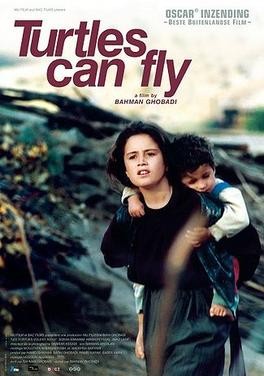

Based on Bahman Ghobadi’s award-winning 2004 drama Turtles Can Fly, this essay examines the dark reality of the Iraq War and foreign occupation. Through the traumatic lives of young characters like Agrin, Henkov, and Satellite—who risks his life clearing landmines—the piece highlights the devastating psychological and social impact of war on civilians, particularly children.
The screenwriter and director of Turtles Can Fly is the Iranian filmmaker Bahman Ghobadi.
The film was made in 2004 and is often described as the first film shot in Iraq after the fall of Saddam Hussein. It was Ghobadi’s third feature film.
Among his works, Turtles Can Fly became particularly successful internationally and received numerous awards. It won recognition at festivals such as Berlin and San Sebastián, while many online film platforms also gave it high ratings.
The central characters can be identified as Agrin, Henkov, and Satellite.
As his name suggests, Satellite is associated with satellite dishes. He installs satellite systems in villages and, through his various economic activities, also helps provide food and work for the children around him.
Almost no one in the villages knows English.
There is an English teacher, but he spends much of his time writing letter after letter to the American president.
The film takes place against the background of war, occupation, and the destruction of Iraq.
Before the American-led invasion of Iraq came the Iran–Iraq War.
Between 1980 and 1988, Iraq and Iran fought an exceptionally destructive conflict.
During that war, the United States supported Iraq, as did a significant number of Arab states.
Among Arab countries, Syria was one of the main governments to support Iran.
Years later, Iran would support the Syrian government during the Syrian civil war and play an important role in preventing the regime from collapsing for a long period.
The United States had previously supported Iraq, but later refused to accept Iraq’s invasion of Kuwait.
The enormous natural resources of Kuwait, together with the strategic balance of the Gulf, made such an expansion unacceptable to Washington.
When the later invasion of Iraq is examined, the justifications presented for it remain deeply controversial.
From the perspective of this essay, the old Western idea of bringing “civilization” to the East also played an important ideological role.
Whenever foreign forces enter the Middle East or the wider East, they often push the region into greater chaos while themselves suffering enormous material and psychological losses.
The American invasion of Iraq has remained an indelible stain on American political history, and its consequences will continue to be discussed for generations.
Agrin and the Human Cost of War
In the film, Agrin represents one of the young girls who suffered sexual violence during the war.
Her mother and father are killed in the conflict, and Agrin herself becomes a victim of rape.
She later gives birth to a child.
At the end of the film, unable to endure the psychological burden of what she has experienced, she kills the child and then takes her own life.
Satellite, meanwhile, falls in love with Agrin almost immediately after seeing her and wants to marry her.
Henkov is Agrin’s brother.
At first, Henkov and Satellite do not get along.
Henkov appears to possess a mysterious ability to foresee future events.
Satellite also wants to know what will happen in the future.
Over time, the relationship between the two boys improves, while Satellite makes repeated efforts to impress Agrin.
Although they are very young, the conditions in which they live force them to mature rapidly.
In societies where state institutions and legal protections have collapsed, children may also enter adult roles far earlier than they normally would.
People who mature early under such conditions may also be exposed to lives that are much shorter and harsher than they should be.
War has devastating consequences for human nature, society, the environment, and psychology.
For this reason alone, states should avoid opening wars with conventional, nuclear, chemical, or other advanced weapons except under the most unavoidable circumstances.
The damage is never limited to soldiers.
It affects humanity as a whole.
Innocent civilians should not be killed.
Children, elderly people, and women must be protected.
War, Occupation, and the Isolation of Villages
As though the region’s internal wars were not enough, foreign powers have repeatedly intervened in the Middle East.
Countries are supposedly independent, yet borders are crossed, societies are occupied, and ordinary people pay the price.
War has had especially destructive consequences throughout the Islamic world.
The invasion of Iraq brought extraordinarily difficult conditions to the region.
Many people in rural Iraq did not know English.
Access to television was limited.
People could not easily obtain reliable news and had little idea what would happen next.
Mobile phones were not widespread as they are today.
Communication and transportation were extremely difficult.
Chemical weapons themselves represent another horrifying dimension of modern warfare.
For the Islamic world, peace and stability are among the most fundamental needs.
No country in the Muslim world should be treated as the backyard of a Western power.
If a village had access to television, how many people living there at that time could even understand what American politicians were saying in English?
Perhaps such people could be found in the cities, but the conditions in villages were dramatically different.
There was nothing comparable to the widespread access to education that exists today.
Transportation alone could become an enormous problem.
Yet regional societies are capable of solving many of their own problems.
There is no need for constant escalation, demonization, and hostility.
Children Who Clear Mines
In the film, bicycles are even used during weddings.
A bride may be transported by bicycle.
Poverty is everywhere.
There is also a child whose predictions seem to come true.
His apparent ability to foresee events causes many problems for those around him.
He has lost both of his arms, yet despite this, he is still able to clear landmines.
Somehow, the children have learned how to remove mines.
Hardship can force human beings to learn things they should never have had to learn.
Whether Kurdish, Turkish, Alevi, Circassian, Sunni, Hanafi, Hanbali, or belonging to another background, every Muslim is our brother or sister.
Only we can truly heal one another’s wounds.
Others cannot do this for us in the same way.
We should not allow political ideologies to rise above Islam.
If we learn to respect one another’s beliefs and worldviews, difficult conditions will not easily destroy us.
As Mehmet Akif Ersoy also emphasized, it is difficult to destroy a people unless division first enters among them.
If, God forbid, our lands were under occupation while internal division still continued, our task would become even harder.
Today, Islamic brotherhood should become one of the dominant principles of the region.
Islamic societies are not intellectually or doctrinally uniform.
There are many different schools, interpretations, and traditions.
Nevertheless, constant lamentation should not become the language of Muslims.
Endless mourning by itself benefits no one.
The Ottoman Empire served Islam for centuries.
That responsibility should continue in a new form.
Yet while acting with such an understanding, we must follow the path of our Prophet.
He was not a prophet-king living in luxury and palaces.
He spoke of “my ummah.”
He did not say that superiority belonged to a small elite.
He said that true superiority lay in piety.
Men who had once buried their own daughters alive could only have listened to someone whose life and morality gave credibility to his message.
What the Muslim World Needs
What we need today is not simply more money or greater wealth.
Some Muslim-majority countries are among the richest countries in the world.
Yet material wealth alone has not solved the problems of the Islamic world.
A section of the Muslim world has lost sincerity and spiritual authenticity.
Mehmet Akif once described sincerity as his true talent.
He said, in essence:
“I lived quietly; how would anyone ever know me?”
Yet today almost everyone knows his name.
His life continues to illuminate our path.
Producing a human being of that intellectual and moral calibre is one of the most difficult achievements a civilization can accomplish.
He was also granted the honour of writing a poem as important and meaningful as the Turkish National Anthem.
By the permission of Allah, beautiful servants are sometimes entrusted with beautiful tasks.
Children Forced to Become Adults
Among the children in the film is an older boy who acts almost as their leader.
He stands out through courage and maturity.
The other children working with him are also remarkably brave.
They clear mines without appearing to fear them.
Difficult times can produce strong people.
During war, even a simple health problem can become impossible to solve.
A person suffering from severe tooth pain may not even be able to reach an emergency room and receive an injection.
War means deprivation.
It means resources being transferred away from ordinary life and toward destruction.
Those who remain behind suffer almost as much as those who go to the front.
As one of our elders once said:
“Making war is easier than making peace.”
When we look at history, states often declared war over remarkably small excuses.
There are always countless reasons and pretexts available for war.
A weak state usually asks for peace.
After the Second World War, however, the international community attempted to construct a new system.
Within this system, occupying another country became much more difficult politically and legally.
An occupation can suddenly turn against the occupying power itself.
The Moral Cost of Empire and War
The Islamic world has suffered deeply from occupations.
Western powers colonized much of the East, but when they themselves abandoned morality, they also paid enormous prices.
The destruction they experienced during the First and Second World Wars can almost be read, from a moral perspective, as the return of the suffering inflicted upon the oppressed.
Homes were destroyed.
People were left without families.
Women were violated.
Entire societies were traumatized.
Those who commit such acts—and the political systems that enable them—should not expect to leave this world without moral consequences.
Our own understanding of civilization should rise to a very different level.
We should reach a stage at which we do not unnecessarily kill even a fly or an ant.
Indeed, I believe civilization should advance even further than this.
Even ants and the smallest animals should have places of care and protection.
Perhaps this sounds unrealistic or excessive.
But I believe we should aim for it.
No living creature should suffer unnecessarily.
We should look at even the smallest being as a creature created by Allah.
We ourselves did not choose to be born as human beings.
We could, in another order of creation, have been a tiny creature unable even to walk or fly.
If a small ant loses the ability to walk, perhaps one day human civilization should be capable of producing a tiny artificial limb for it.
If a flying creature loses a wing, perhaps we should dream of a civilization advanced and compassionate enough to help it fly again.
That is the civilization I imagine.
If we aim for such a level of compassion, an entirely different world may become possible.
And when we speak of supply and demand, we should also ask:
supply and demand according to whom?
Anything that is morally right and genuinely beneficial should be pursued.
A proper society should make room not only for human beings but for the smallest creatures within creation.
That is my understanding.
If someone belongs to a faith that teaches such compassion toward even the smallest living beings, then deliberately causing suffering to innocent members of that community is not something that can be morally ignored.
God, in His justice, will ultimately call everyone to account.
Ozan Dur

Yorumlar
Yorum Yaz