
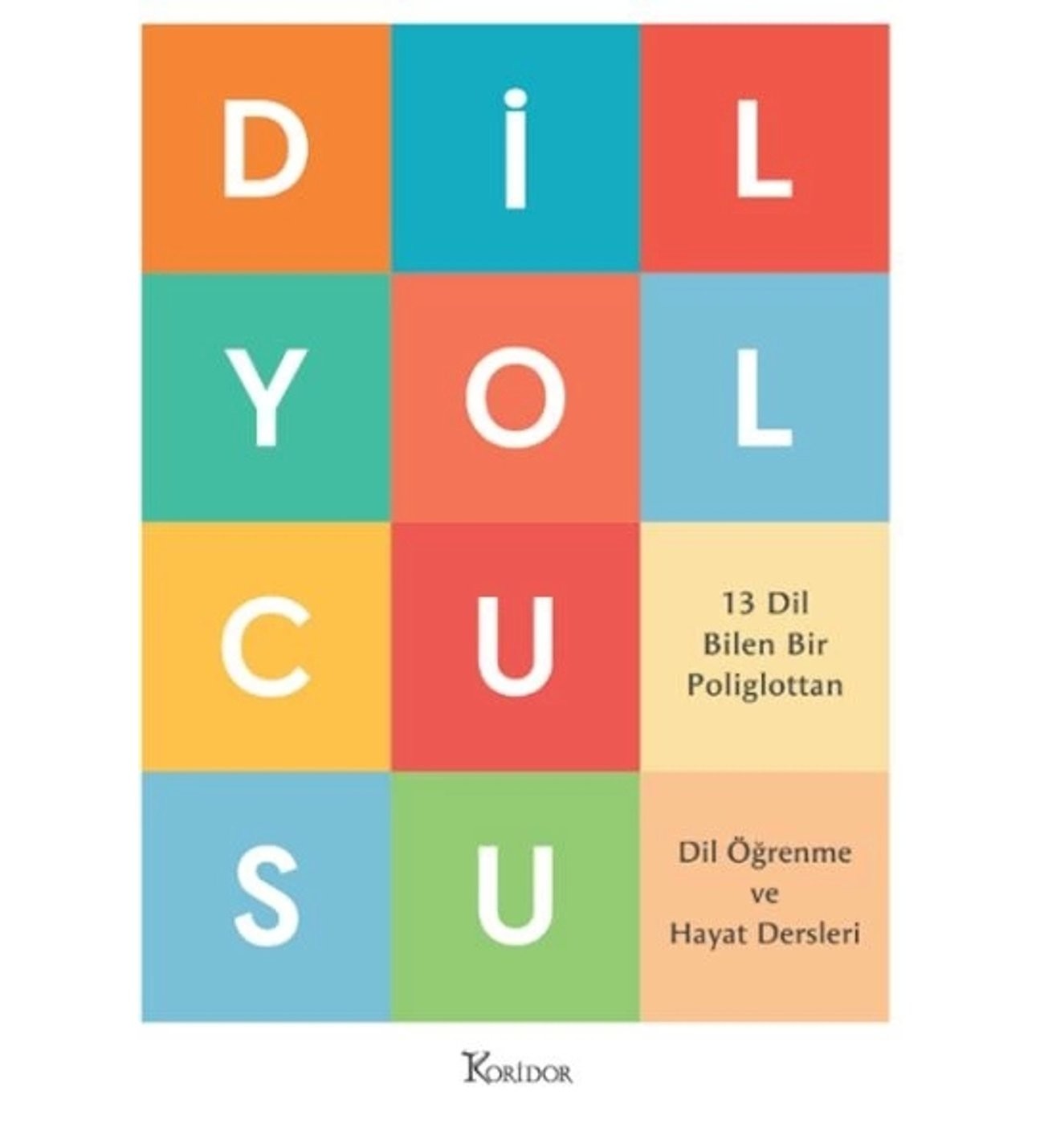

This article reviews the 378-page book Dil Yolcusu (The Language Traveller) by Semih Uçar—a polyglot fluent in thirteen languages, academic, and language coach—published by Koridor Publishing. Highlighting Uçar’s core life mission to support individuals who feel stuck saying "I want to, but I can't," writer Ozan Dur emphasizes that language acquisition is not merely about memorizing vocabulary, but about utilizing languages as tools for research, academic growth, and cultural synthesis.
Recently, I came across Semih Uçar’s book Dil Yolcusu (The Language Traveller), and while reading it I encountered this subject.
I would also like to introduce the book itself.
Semih Uçar is a polyglot who knows thirteen languages. He has completed postgraduate and doctoral studies and has also worked extensively in the field of foreign languages. He has translated books for prestigious publishing houses and has been active in writing, translation, language teaching, and language coaching.
I have been following him for some time, reading what he writes and observing his efforts in this field.
He wrote a 378-page book published by Koridor Publishing. One of the main aims of the book is to challenge misconceptions about language learning.
He has a large following and enjoys reading in different languages and learning new ones.
The languages he knows include:
Turkish as his native language, English, German, Spanish, Italian, French, Latin, Serbian-Croatian, Polish, Russian, Persian, Arabic, and Japanese.
He also conducts research on many other languages.
Videos of him using or discussing some of these languages can be found online.
German and English are among the languages he knows best. He has taught both for many years and has also worked as a language coach in these languages.
Although he has not been actively coaching learners in various languages for some time, he has significant experience in this field.
His professional career originally began in music, but he later developed himself considerably in foreign languages as well.
In my opinion, his work in language learning made him even more widely known and helped him gain a larger following.
Semih Uçar explains his purpose in life in the following words:
“Can you express the purpose of your life in a single sentence?
As someone who has spent many years reading, thinking, and writing about these subjects, I used to believe that I could answer this question very easily.
Yet when I encountered this question in a book I read a few months ago, I could not answer immediately.
For several days, I had to search deep within myself for the answer.
Eventually, I found it.
In one sentence, my purpose in life is this:
I will help people who say, ‘I want to, but I can’t,’ do what they want to do and achieve what they want to achieve.
Why is this my purpose in life?
Because I cannot stand hearing someone say, ‘I want to, but I can’t.’
That is one of the things that disturbs me most in life.
When someone says, ‘I want to, but I can’t,’ it is the language of regret.
And I know that a person who says this may carry that regret for the rest of his or her life.
In my view, regret is one of the worst emotions a human being can experience.
Regret is perhaps the greatest poison that can enter us.
It is a poison that slowly kills us day by day.
For that reason, when I hear someone say this and fail to help them do what they want to do, I feel almost as though I am refusing to help someone who is about to commit suicide.
That is why this is my purpose in life:
I will help people who say, ‘I want to, but I can’t,’ do what they want to do and achieve what they want to achieve...”
I would like to share ten misconceptions discussed in his book.
I cannot reproduce all the details because that would effectively mean reproducing the book itself.
However, I still want readers to recognize some of the misconceptions we often accept as truths and begin questioning them.
If even one person begins reconsidering such assumptions, that would already be a success for me.
If I can contribute to even one person’s language-learning journey, that would make me happy.
In my opinion, something even more important than learning a language is using that language to conduct research and contribute to our academic and cultural world.
Misconception 1: “Languages Are Best Learned—or Can Only Be Learned—at a Young Age”
Is this true?
Of course not.
Adults can actually possess several advantages in language learning, and there are many variables involved.
For the details, I strongly recommend consulting the book.
Misconception 2: “You Need a Natural Talent for Languages”
Is this true?
Again, no.
A person who consistently takes an interest in languages will naturally improve and eventually surpass someone who shows no interest.
Such people are then often described as “naturally talented.”
But is that necessarily true?
Would we say that someone who reads many books is “naturally talented at reading books”?
Probably not.
The details are explained more fully in the book.
Misconception 3: “You Need to Be Highly Intelligent to Learn a Language”
This is also highly misleading.
Semih Uçar quotes the following idea:
“Of course, not everyone is equally intelligent or equally talented. But everyone is intelligent and talented enough.”
He emphasizes that language learning has no simple direct relationship with IQ.
Misconception 4: “I Need to Sit in a Classroom and Listen to Lessons in Order to Learn a Language”
This idea is incomplete and often wrong.
In my opinion, people who have become overly accustomed to formal schooling and remaining passive in front of information are more likely to think this way.
However, the internet and platforms such as YouTube have transformed language learning dramatically.
There is an enormous world outside the classroom waiting for us.
The important thing is to discover our own interests and begin without postponing.
Misconception 5: “A Language Is Best Learned—or Can Only Be Learned—in the Country Where It Is Spoken”
Is this true?
Of course not.
Instead of saying:
“I did not learn the language because I did not work hard enough,”
we often hide behind excuses.
Many people in Türkiye know İclal Dağcı.
She learned several languages without going abroad.
I like to think that examples like hers help break this misconception.
Misconception 6: “Learning a Language Requires Many Years”
We study foreign languages for many years at school and still often fail to learn them properly.
So perhaps the real issue is not simply time.
As Uçar argues, the problem lies elsewhere.
For the fuller explanation, examine the book.
Misconception 7: “I Need a Lot of Money to Learn a Language”
As Semih Uçar points out:
“At no point in history have people who wanted to learn languages had access to so many free or extremely inexpensive resources.”
I think this sentence explains the matter sufficiently.
There is little more that needs to be added.
Misconception 8: “I Need a Lot of Free Time to Learn a Language”
Is this true?
Again, no.
You do not necessarily need five hours every day.
But young people who spend countless hours in cafés should probably not say that they cannot find even thirty minutes.
Most people can find half an hour or an hour a day if they truly decide to do so.
And meaningful progress can be made with that time.
Misconception 9: “Languages Can Only Be Learned Through Grammar Books”
Is this true?
Certainly not.
If grammar books alone were enough, everyone graduating from school would already know a foreign language.
Studying grammar and knowing grammatical rules do not mean that you actually know the language.
And if grammar is never used, it will eventually be forgotten.
Misconception 10: “There Is Only One Correct Technique for Learning a Language”
Is this true?
Absolutely not.
Unfortunately, there is no “magic technique” or magic wand.
There are dozens of methods.
Once you spend enough time around languages, you begin to realize that there is no hidden “secret.”
The path itself is the secret.
These points are based on Semih Uçar’s book. They are discussed in much greater detail in Dil Yolcusu.
I strongly recommend taking a look at the book.
If any of these points raise questions in your mind, or if you want the book to guide your language-learning process, it may be very useful.
While studying a language, it can also be beneficial to spend perhaps 5–15 percent of your language-learning time learning about methods and techniques.
But this should definitely be done while actually studying the language, not instead of studying it.
Many thanks to Semih Uçar for his work and contribution.
Ozan Dur


Yorumlar
Yorum Yaz