
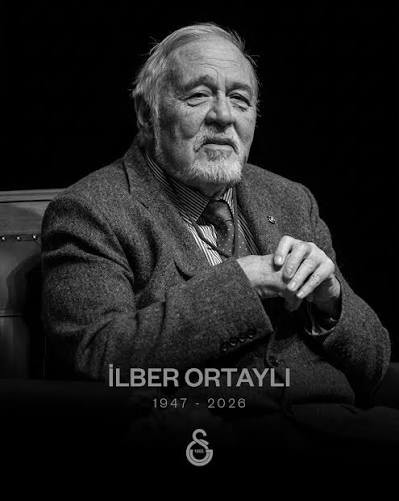
İlber Ortaylı emphasizes that language acquisition must happen early in life (ideally before age 25), as advanced language mastery becomes significantly harder after 15, and memory declines after 50.
İlber Ortaylı’s Language Learning Method
(Excerpted and prepared from the book "Bir Ömür Nasıl Yaşanır?" [How to Live a Life?])
İlber Ortaylı was born in 1947. He completed his primary and middle school education in Istanbul and Ankara. In his writings, he particularly emphasizes how much he benefited from Ankara’s cultural environment. By taking advantage of language courses in Ankara, he was able to learn several languages there. In this article, we will talk about İlber Ortaylı’s language learning methods and his recommendations regarding language learning. Almost no direct questions were posed to the Professor regarding his language learning methods, but a small amount of information is available on this subject. By adding his recommendations, an attempt will be made to form a coherent text.
According to İlber Ortaylı, students should learn whatever they can until the age of 25. Leibniz completed his doctorate at the age of 19. Among Russian writers, Pushkin and Lermontov died before reaching the age of 40, leaving behind great works. There are numerous authors who produced works in their thirties and forties. İlber Hoca states that after the age of 50, due to memory loss, serious works cannot be written. However, exceptional professors like Halil İnalcık, who continued to write works even after the age of 90, can be found. “Let us talk about the French Egyptologist Jean-François Champollion. This famous scholar had already completed everything while still a child, by the time he reached 16. At thirty, he deciphered hieroglyphics. He passed away from this world at the age of 42. So, his final work was deciphering hieroglyphics—solving the unknown. Until then, he had abandoned neither Aramaic, Greek, Hebrew, nor Latin.” According to İlber Ortaylı, a language is learned at an early age. He states that after the age of fifteen, learning a language at an advanced level is no longer possible. We scientifically know that children begin abstract thinking after the age of 12, and once they start thinking abstractly, they can learn grammar rules. However, before this age, they acquire the language. Scientifically, we also know that children can learn up to seven languages. Yet, even if they acquire the language, reaching advanced levels only becomes possible at the earliest toward the end of high school and the beginning of university. İlber Ortaylı also states that there can be no formal education after the age of 25; a person should move on to producing works.
According to İlber Ortaylı, language is the most important tool for expanding beyond the boundaries of the environment we are in. Knowing one language is not enough either. He advises that we should know two or three languages. There is no need to learn nine or ten languages and become a polyglot. Knowing English is not enough, and not every book can be found in English. The best books are not always in English. However, if we are a doctor or an engineer, English may suffice. If we are someone who engages in matters that do not directly concern us—that is, if we are an intellectual—one language is not enough.
İlber Ortaylı knew French, and he explains his journey of learning French with these words:
“Zeliha Berksoy’s father, Ercüment Siyavuşoğlu, helped my French immensely. One day we were sitting and talking: ‘Sir, this won’t work without French!’ he cut short and said. ‘Well, how will it happen then?’ ‘Sit down, I’ll teach you,’ he said. We would sit for five hours at a time… And he did teach me. You’re asking for a method: Ercüment Bey’s method was very simple and useful: ‘I’ll throw the dictionary at your head!’ he would warn me; so you had to look at the dictionary, never keep it out of reach, otherwise you’d make a mistake. When I made a mistake, Ercüment Bey would call me ‘Donkey of donkeys!’ This work is actually practiced like this; the old way is like this. I haven't seen a better method since.”
İlber Ortaylı was closely engaged with dictionaries. As can be understood, he also memorized vocabulary. The fact that he kept a dictionary constantly at hand indicates that he read texts. He must have read texts regularly, which is why he never dropped the dictionary from his hands. Before artificial intelligence, the most important language learning aids were dictionaries. Perhaps the most important one, or at least one of the most vital aids.
To the question “How many languages do you know?”, İlber Ortaylı answers as follows:
“As many as a history or law professor at a European university knows. There is no such thing as perfect, good level, or legendary; there is no need for this either. Because that is not what matters. I don't know many, but I learn the languages I have learned through the method I just described. Mostly on my own, and sometimes with the help of those close to me.”
İlber Ortaylı says that he learned languages on his own at a very early period. Although self-learning materials have become widespread only nowadays and perhaps over the last seven or eight years, having such an opportunity was hardly possible for the general public before. Yet İlber Ortaylı states that there were languages he learned on his own at a very early period. This is indeed a great achievement. Even today, despite having so many materials, people cannot learn on their own. However today, compared to the past, it is possible to come across numerous YouTubers announcing that they learned languages on their own. İlber Ortaylı continues:
“As I emphasize, the main point is to learn the language early; especially old scripts or languages with different alphabets must be learned very early. For others, it’s fine if you are a bit late.
Granted, I started German when I was 11, and by the time I was 14, I was reading German books. I would sit in the German library and read extensively. I attended the courses given by Heinz Kristinus at the Goethe Institute; he was the one who made me embrace German. I started English and French relatively late. What a beautiful language French is! To tell the truth, I didn't know it was that beautiful until Ercüment Bey taught me this language, but I couldn't have guessed it to this extent either. I can't say there is no language more beautiful, because there is. Latin itself is more beautiful.
You ask how many languages I know; in reality, this has no importance at all. The pleasure of speaking a language and living it is far more important. I take pleasure in this. Sometimes I can use a language very beautifully; I can resort to its jokes and fine phrasing. Sometimes not as much. I enjoy this very much. I already advocate that language is poetry. Speaking a language is acting—that is, a theatrical thing. I would say language is humanity's greatest invention, but perhaps language is not an invention of humanity; we are organisms directed by it.
Language is truly a very interesting thing… The relationship between language and human beings in terms of consciousness is vital… That’s why I have always loved topics related to language since ancient times. In fact, reading about these topics pleased me more than reading philosophy. Styles of rhetoric, official rhetoric styles, refined speech… I adored these. I used to read German diplomatics and such. In Vienna, I struggled to decipher the script called Kurenth. For my associate professorship thesis, I needed to work in the German and Austrian archives. I used to memorize such things (certain forms of address and titles, i.e., titulature) that I found in German archives. Well, everyone has a quirk, and mine is this.”
When asked “Among the languages you know, which one is your favorite?”, İlber Ortaylı gives the following answer:
“I don't like Arabic. It is based on very strict rules of logic. The beautiful one is Farsi [Persian]. That one actually makes a person fall in love with it. Gurben olmuşem [I have become a sacrifice for it] (laughs). But it is not the language I know best. I know Turkish best. I'm not joking. Let us learn languages, yes, but let us not forget our own language either. I live and breathe Turkish. I never depart from my own language; I take care of it. Everyone must show this care as well. I have no tolerance for those who ruin pronunciation and speak from behind their teeth. People like that even become presenters and news anchors in the media. Poor Turkish! How beautiful you are, and what unconscious, ignorant, and arrogant children you have; they are ruining you.”
Following this, İlber Ortaylı states that the interest in Persian has increased, which is pleasing. He mentions that Iranians organizing courses cannot keep up with student demand. Since the number of people learning Greek has also increased recently, the Professor touches upon this topic as well and expresses his joy. He states that within ten years, those who study history knowing only English and using a bit of Ottoman Turkish will have no credibility left.
İlber Ortaylı attaches great importance to speaking when learning a language. In one statement, he includes the following sentences: “… As we were growing up, tourists genuinely started arriving from here and there. Maybe not every day, but eventually they came, and their numbers were gradually increasing. We used to guide them around and inform them. It is very clear that my language developed like that too—by speaking and speaking. Mind you, I hadn't even turned 18 yet; I was in high school.” Here, the Professor emphasizes his age once again and mentions the benefit of practicing speaking at an early age. Especially in a world without today's YouTube and podcasts, interaction was far more important. There is a saying among polyglots: “Knowledge that does not enter through the ear does not come out of the mouth.” İlber Ortaylı listened extensively and then developed himself through speaking practice.
In one of his speeches, the Professor talks about the inefficiency of Imam Hatip schools. And he argues that two dead and two living languages should be taught there. The information conveyed here is excerpted from the book titled Bir Ömür Nasıl Yaşanır? [How to Live a Life?], prepared in an interview format with the Professor. In the book, the issue of education is among the leading topics the Professor emphasizes. For instance, he mentions that literature high schools should be opened. He expresses that he attaches great importance to language learning in education. He says, “Good education happens with music, mathematics, philology, and sports.” He also states that culture is the most valuable element holding a nation together.
He is not against memorization in language learning and supports it. He emphasizes that memorization must definitely find a place for itself in education. To read from his own sentences, he speaks as follows:
“… Since the cave age, since Mesopotamian teachers, since Aristotle's Academy, people learn not by understanding, but by memorizing. To understand, one must first memorize. The Church realized this. The Islamic world of the Middle Ages understood this. First you memorize! Because children and young people are very inclined toward memorization; they can memorize everything. They learn even language by memorizing patterns. Understanding comes after memorization. Memorization and repetition are the foundation of education. Languages, mathematics, and geography are all learned by memorization.”
İlber Hoca encourages memorizing sentences and patterns. We can understand this better from another one of his sentences:
“Do you know, French theater is also functional for language learning. Those learning French should try to memorize certain sentences, dialogues, lines, and soliloquies—for example from Racine; they should read Molière in the original. La Fontaine should also be read for the same purpose. These are important sources for language education; they help in daily conversation. Some of the translations into our language are good, while some should be avoided.”
Here, the Professor also explicitly points out that reading helps in daily conversation. We know from experience that reading stories intensively makes a significant contribution to daily conversation. The Professor also emphasized this here. When directly asked “What is your method?”, İlber Hoca did not give a direct answer, but these are what we understand from what he said from time to time. We would have wished to suggest many more methods and techniques, but İlber Ortaylı did not provide many recommendations on this matter.
Finally, one of the methods he recommended is this. İlber Ortaylı says, “I would take a page in my hand.” “I would read that page over and over until I understood it one hundred percent.” He states, “Thus, I gained familiarity with words I didn't know.” “When that page was done, I would move on to the next page,” he says. This is a great method, and it enables you to learn words in context. It is also very useful for learning new vocabulary. Learning words this way up to the B1 level is very beneficial because you learn frequently repeated ones in a short time. And if you can find a work suitable for your level, you can consider half the language already in your pocket.
We hope our article will be useful to its readers, and we wish God's mercy upon İlber Hoca.
Ozan Dur
Yorumlar
Yorum Yaz