
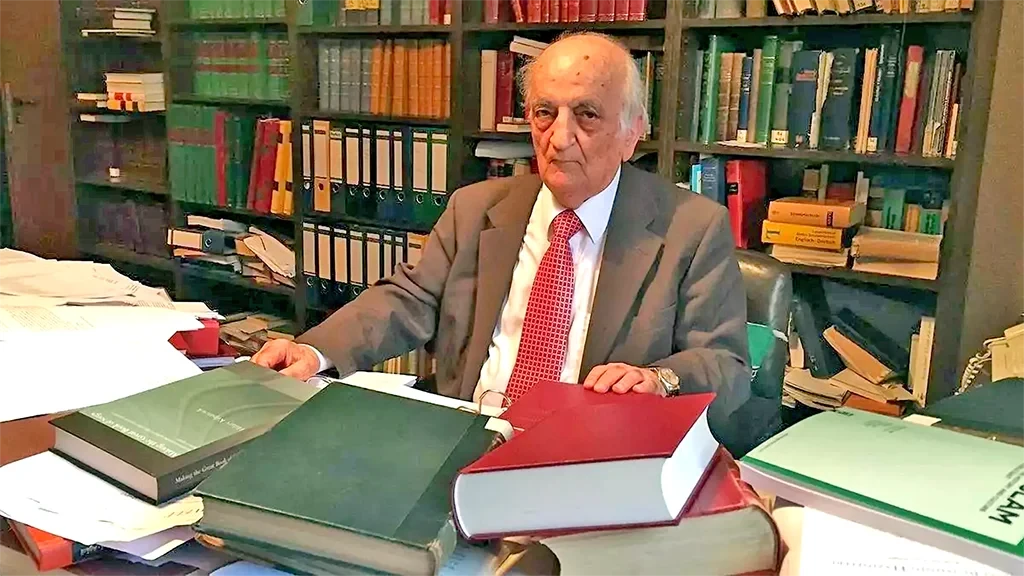
Fuat Sezgin’s remarkable language-learning journey demonstrates the power of determination, disciplined study, grammar, and intensive reading. By treating languages as essential tools for scholarly research, he gained access to the scientific heritage of the Islamic world and became one of the most influential historians of science.
A Life Dedicated to Islamic Science
Fuat Sezgin was born in Bitlis in 1924. One of five siblings, he was the son of Mehmet Mirza Efendi and Cemile Hanım. His family lineage can be traced back to the Hasankeyf branch of the Ayyubids. Fuat Sezgin received his early education from his father, who taught him Turkish grammar. Perhaps this was the source of the great emphasis he later placed on grammar in language learning. Two of his brothers served as members of parliament and government ministers. The fruits of his efforts played a major role in his becoming widely recognised. The year 2019 was declared the “Year of Fuat Sezgin.”
Fuat Sezgin was very fond of mathematics and had decided to study engineering. However, attending a lecture by Hellmut Ritter directed him towards the history of science. Ritter was aware of the value of the intellectual heritage of Türkiye and the Islamic world. This must have had a particular influence on Fuat Sezgin. Over time, Sezgin’s aspirations concerning the Islamic world became increasingly clear. Since he could not surround himself with the ideal people he desired, he had to remain alone and carry on his struggle by himself. While the people of his time were concerned with money, rank, and position, Fuat Sezgin was thinking about the Islamic world. The present condition of a society that had once established a great civilisation deeply saddened him. He felt obliged to do something, and he achieved his goals through a strong sense of “responsibility” and “hard work.” Esra Gözeler explains the two most important words that describe him as follows:
“Becoming closely acquainted with Fuat Sezgin’s life and works perhaps demonstrates that the meaning of life is simply to work. Fuat Sezgin existed in this world by working, producing, constantly occupying himself with something, and making his time fruitful…”
As Esra Gözeler also points out, Fuat Sezgin adopted hard work as a guiding principle in life. He was known for working up to seventeen hours a day. He observed every minute and valued time to such an extent that he virtually displayed the same determination shown by the scholars of earlier centuries in their pursuit of knowledge.
Among the people who influenced Fuat Sezgin most were his wife and his teacher, Ritter. He stated that it was thanks to his wife that he was able to write his monumental and enduring work, Geschichte des Arabischen Schrifttums (GAS), or History of Arab-Islamic Sciences. He dedicated one of its volumes to his wife, another to his daughter, and another to his teacher Ritter. His daughter stated that, for many years, she could not fully comprehend her father’s contribution to the history of science. It appears that he was modest enough not to speak boastfully about himself even to his family. Perhaps he did not explain these matters to his daughter in depth. Some people’s lives consist entirely of action, leaving no need for words. History itself is then compelled to explain them. It is highly likely that Fuat Sezgin was one of those people.

Istanbul Museum of the History of Science and Technology in Islam – Kafkas Edu
Another figure who influenced him was his teacher, Ritter. While Sezgin was planning to study engineering, he happened to attend one of Ritter’s seminars and consequently chose to study Arabic-Persian philology. He had already begun learning Arabic, but he took advantage of the interruption caused by the Second World War and reached a good level in the language within six months. As far as I understand, he learned Arabic comparatively. His primary goal was reading, to which he attached great importance. It seems that he attempted to read difficult texts and, even when he could not understand them, he did not give up but continued reading. It would be unreasonable to assume that graded stories for different proficiency levels were readily available at the time. He attempted to learn Arabic through difficult works of Qur’anic exegesis. He studied comparatively, consulting the Arabic text on one side and its Turkish counterpart on the other. In other words, he climbed the ladder of language learning by leaping eight or ten steps at a time and attempted to learn it through the difficult path. Once he had made a decision, there was no turning back.
Fuat Sezgin never stepped back or fell into despair. Although he planned everything in his life, matters did not always proceed as expected. When he read in a newspaper that he had been dismissed from the university following the 1960 military coup, he did not lose hope. Instead, he went to the library and continued studying manuscripts. With such a profound devotion to knowledge, even adverse developments could not discourage him.
The exact number of languages Fuat Sezgin knew remains uncertain. We can say with confidence that he knew Turkish, Arabic, Persian, Russian, German, and probably English. He learned the languages he needed, and his objective was not to speak them. He learned languages primarily through reading. His wife, who converted to Islam, said the following about him:
“…I would also like to add that it is not actually important to know how many languages my husband knew. It may be somewhat discouraging, and knowing this would not benefit anyone. What matters is studying the language or languages that allow you to access the literature of your field of interest and that you need in order to answer scholarly questions. In my opinion, it is also unnecessary to know how many hours a day he worked. Praise be to Allah, he had a strong constitution that enabled him to do this with very little sleep. May Allah’s peace and blessings be upon you.”
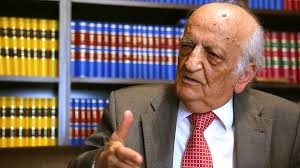
Fuat Sezgin – Anadolu Agency
He worked tirelessly for future generations. Professor Mehmet Akif Koç recounted the following about him:
“When I asked him, ‘Professor, is there a method for working without stopping?’ he replied: ‘I feel that every cell in my body is in desperate need of rest. Yet whenever I feel this, I consider the present condition of the Islamic world and convince myself once again that I have no right to rest.’”
Fuat Sezgin had kept himself hidden from us, and he explained his reasons as follows:
“Fifty years ago, I concluded that no progress could be made with the Muslims presently living. I therefore decided to prepare materials for an imagined future Muslim generation that would not be obsessed with money or status, that would be concerned with confronting the West intellectually, and that would have no problem with hard work. That is why I kept myself hidden.”
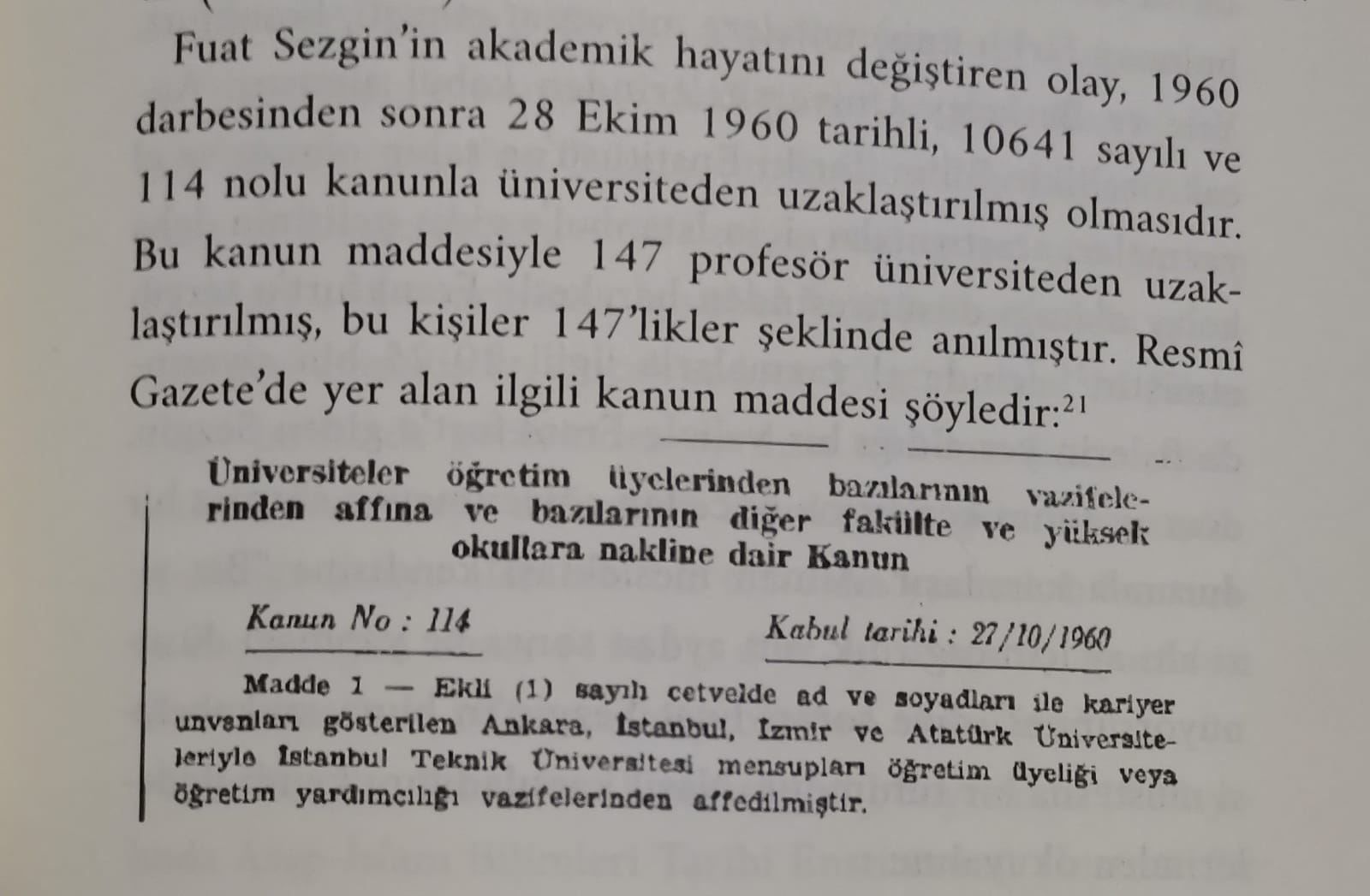
Esra Gözeler – Fuat Sezgin’s dismissal from the university as one of the “147” academics
Let us now examine Fuat Sezgin’s language-learning journey.
Fuat Sezgin was deeply influenced and even fascinated by his teacher Ritter. Ritter assigned Fuat a difficult task. He may also have wanted to test his student. He asked Fuat Sezgin to learn Arabic. Let us hear this part directly from Sezgin:
“I had already begun learning Arabic, but I was making no progress. Despite all my efforts, my teacher was not satisfied with me during the first months. It was 1943. The Germans had entered Bulgaria. Our government suspended education at all universities and schools. My teacher said to me: ‘You now have an opportunity. You will have a six-month break; learn Arabic during this period.’ I had already been thinking the same thing, but his words had a profound effect on me. I truly devoted myself to learning Arabic for six months. We had a thirty-volume copy of al-Tabari’s Qur’anic commentary at home, inherited from my father. I began reading it. At first, I could not understand it. By comparing it with Turkish commentaries, I gradually attempted to penetrate the meaning of the text. I worked approximately seventeen hours a day. I woke up early, went to bed late, and hardly ever left the house. After six months, I had completed all thirty volumes of al-Tabari’s commentary. By the end of those six months, I could read the commentary, which I had initially understood almost nothing of, as easily as a newspaper. If you work at that pace—that is, seventeen hours a day—you can also achieve this; I am certain of it. At the first seminar, several German scholars and professors were present. My teacher placed al-Ghazali’s Ihya before me and said, ‘Let us see you read this!’ I read it. Al-Ghazali was no longer a problem for me. My teacher looked at me, smiled, and was delighted. He praised me a little in front of those present. For me, that moment was one of the most unforgettable moments of my life. I had now reached the level at which I could read books in Arabic. It was therefore necessary to turn to other languages.”
Fuat Sezgin attached great importance to grammar. He regarded his father’s teaching him Turkish grammar as one of the principal sources of his success. Let us hear his account of these developments in his own words:
“…Unfortunately, Turks have a complex concerning Western languages—that is, concerning language learning. This must be overcome and eliminated. In Europe, you cannot imagine a university graduate who cannot speak English, but unfortunately, languages are not known in our country; there is a language complex. There is also something else… Unfortunately, when I was in the third year of primary school, the Minister of Culture—I do not know which minister it was, some narrow-minded person—removed grammar from Turkish schools.
“My father said to me, ‘Let me teach you sarf-ı Türkî.’ Grammar was called sarf-ı Türkî at the time. If I have been able to become a historian of science today, my father’s teaching me sarf-ı Türkî had a very significant influence on this. If I was able to understand the first lectures of the German scholar Ritter, perhaps the fact that I had developed a certain grammatical way of thinking played a role. Turks do not possess sufficient knowledge of grammar, and this is why they cannot learn languages. Sometimes they speak well, but they cannot write. This is one of the major problems of our nation.”
Fuat Sezgin also attributed an important part of his success to his father. I believe that children who have a good relationship with their fathers are more likely to become successful, especially when the father is a scholar or has an appreciation for knowledge, as can be seen in examples from both history and the present day.
Fuat Sezgin also made the following remarks about language learning. These statements are repeated in many books as well. However, our professor did not offer a detailed methodological proposal:
“I also recommend that you sit at your desk and read. However, while sitting at your desk, your mind should not be wandering along Oxford Street, the Champs-Élysées, or Suleiman Pasha Street in Cairo! I recommend that you sit at your desk and read with both your mind and body fully present. Muslims today spend their lives travelling on aeroplanes, trains, and in automobiles. Yet they need to think and develop their ideas through reflection. One must be willing to make some sacrifices. Let me add one more thing: While writing these books, I sometimes become tired at my desk. Occasionally, I want to rest for a while. Then the following immediately comes to mind: Time is passing—time! Time is passing! I become angry with myself and say, ‘How can you allow yourself time to rest?’ Then I immediately stop resting and force myself to continue writing. In other words, we must become a nation that reads, writes, and thinks. None of this can be achieved without languages. Among Turks, there is a fear of foreign languages, and this fear must be overcome. It naturally stems from a lack of grammatical knowledge. Millions of people write and read, and we can only comprehend the conclusions they reach through knowledge of their languages. I learn languages in order to read what has been written in them. Once I bring a language to a level at which I can read books written in it, I stop studying it. In other words, I am not a linguist. I regard languages merely as instruments. I call upon Turks to free themselves from the fear of languages and immediately embrace grammar!” (Turan, 2018, p. 105).
Conclusion
Fuat Sezgin did not have access to extensive information about language learning. He attempted to learn through whatever materials were available to him. He had chosen an extremely difficult method. Nevertheless, in the face of his determination, even this difficult method became manageable and yielded to his will. It is said that a determined mouse can pierce through a wall. I believe that if a student works seventeen hours a day, even if they follow the most ineffective method but refuse to give up, they can learn the language they desire. This is because we discover ourselves and learn different methods over time.
It is evident that Fuat Sezgin displayed an almost superhuman level of effort. Reading at elementary levels is generally enjoyable and easy. According to contemporary pedagogical knowledge, proficiency should be increased gradually. Nevertheless, Fuat Sezgin succeeded in accomplishing what was difficult. This also demonstrates the strength of his will. Some of our respected elders advise that those who wish to learn a foreign language should first possess a sound knowledge of the grammar of their mother tongue. Professor Fuat Sezgin shared this view. He attached considerable importance to grammar and sought to learn each language properly. In this respect, he serves as an example for us.
Books Written About Fuat Sezgin
Karakaş, Ali. Hadis Oksidentalizmi ve Fuat Sezgin. Istanbul: Ensar, 2017.
Sever, Cumali. Bilim Tarihine Adanan Ömür: Kırk Derste Fuat Sezgin. Istanbul: Ensar Neşriyat, 2019.
Yılmaz, Adnan. Bilimler Tarihi Dostu Prof. Dr. Fuat Sezgin. Ankara: NG Yayıncılık, 2019.
Özkan, Âdem. Bilim Tarihinde Ezberbozan Prof. Dr. Fuat Sezgin’le Birlikte. Istanbul: Üsküdar Belediyesi, 2019.
Turan, Sefer. Fuat Sezgin ile Bilim Tarihi Sohbetleri. Istanbul: Pınar Yayınları, 2024.
References
Gözeler, E. (2022). Fuat Sezgin. Diyanet İşleri Başkanlığı Yayınları.
Turan, S. (2019). Bilim Tarihi Sohbetleri. Pınar Yayınları


Yorumlar
Yorum Yaz