
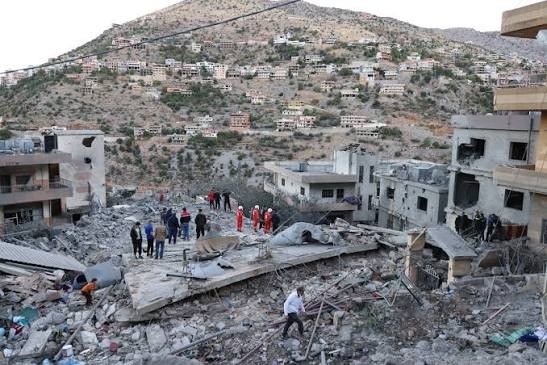

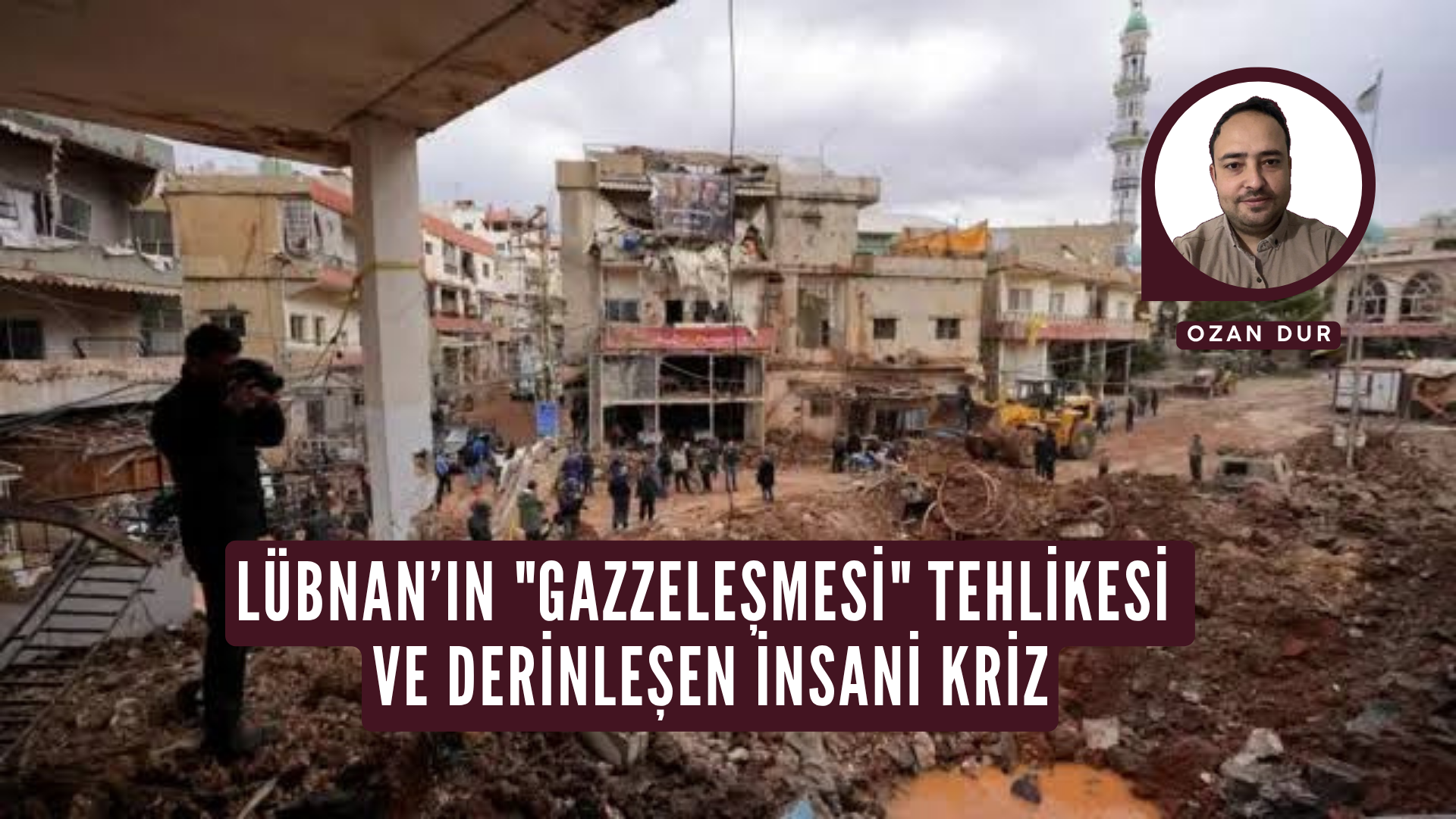
This analysis examines the growing risk of Lebanon’s “Gaza-ization” amid escalating Israeli military operations. It focuses on the destruction of civilian infrastructure and agricultural land, mass displacement, economic devastation, and Lebanon’s growing humanitarian crisis. The article also explores the role of Israeli domestic politics and security narratives in sustaining military escalation, while warning that continued destruction could deepen regional instability and create a long-term humanitarian disaster.
Brief Analysis: The Risk of Lebanon’s “Gaza-ization” and the Deepening Humanitarian Crisis
Introduction and General Framework
The balance of power in the Eastern Mediterranean and the Middle East has entered a new and extremely dangerous phase as Israel has intensified its military operations against Lebanon in recent months. Israel’s cross-border military strategy is no longer limited to direct lines of confrontation; it has increasingly become a direct threat to the internal security, territorial integrity, and social stability of neighboring countries.
The current situation points to a process of “Gaza-ization” beginning in southern Lebanon and potentially spreading toward the country’s interior. The systematic destruction of civilian infrastructure, displacement of populations, and deterioration of economic and social life raise serious concerns that Lebanon could face a humanitarian crisis resembling the devastation witnessed in Gaza.
1. Military Strategy: Desertification and the Destruction of Livable Spaces
Israel’s strategy along Lebanon’s southern border appears to extend beyond purely military objectives, increasingly affecting civilian life, agricultural land, and economic infrastructure.
Destruction of Agricultural Land and Residential Areas
The destruction of agricultural land, homes, and civilian infrastructure in border areas can be interpreted as part of a broader process aimed at depopulating the region and making it increasingly difficult to live there. The destruction of the physical environment not only causes immediate humanitarian suffering but also undermines the economic foundations that allow local communities to remain in their homes.
Agriculture is particularly important in this context. The destruction of farmland deprives communities not only of their present livelihoods but also of their capacity to recover economically in the future. Such a process risks turning once-inhabited agricultural areas into increasingly uninhabitable zones.
Mass Displacement
The continuing clashes and bombardments since March have reportedly displaced nearly one million people. This represents more than a temporary humanitarian emergency. Large-scale displacement reproduces a pattern of repeated uprooting that has increasingly become part of the region’s political and social reality.
The danger is that displacement may cease to be a temporary consequence of military operations and instead become a structural feature of the conflict. Once communities are uprooted, returning home becomes increasingly difficult as houses, agricultural land, schools, businesses, and essential infrastructure are destroyed.
2. Humanitarian Crisis and Socio-Economic Devastation
Faced with Israel’s security-centered military doctrine, Lebanon is struggling to respond effectively because of the country’s already fragile state institutions and severe economic difficulties.
Shelter and the Risk of a Humanitarian Disaster
Displaced populations are facing increasingly difficult living conditions as rents rise sharply and adequate shelter becomes scarce. Many people are reportedly forced to seek refuge in streets, vehicles, schools, and other temporary spaces.
While such conditions may be relatively more tolerable during the summer months, the approaching winter could transform the existing humanitarian emergency into a far more severe disaster. Without sufficient shelter, heating, healthcare, food, and sanitation, large-scale displacement could create a second-order humanitarian crisis extending far beyond the immediate consequences of military operations.
Social Structure and Sectarian Fragility
Lebanon’s highly sensitive sectarian and political balance makes the country particularly vulnerable to large-scale population movements. The state’s already limited capacity to absorb internally displaced populations is placing additional pressure on communities and local institutions.
Large-scale internal migration can intensify competition over housing, employment, public services, and humanitarian resources. In a country characterized by delicate sectarian balances, these pressures could deepen existing social tensions and create new political fault lines.
Loss of Employment and Economic Collapse
The humanitarian crisis extends far beyond food and shelter. Large sections of the population have lost their livelihoods as economic activity has been disrupted and infrastructure has been damaged.
For many people, the destruction of businesses, agricultural land, transportation networks, and local infrastructure means that returning to work will be increasingly difficult even after the fighting ends. Consequently, the conflict risks producing a long-term economic crisis in which displacement and unemployment reinforce one another.
The destruction of economic infrastructure therefore has implications extending well beyond the immediate battlefield. It can undermine the ability of communities to recover and may create conditions in which displacement becomes permanent.
3. Israeli Domestic Politics, Public Opinion, and the Cost of War
Israel’s broader military posture toward its neighbors is also closely connected to domestic political dynamics.
The Security Narrative and the Iranian Threat
The Israeli government has effectively used narratives centered on security, Iran, and the threat posed by Iran’s nuclear program to maintain domestic support. Such narratives can help consolidate public opinion around the government during periods of prolonged military confrontation.
The framing of regional conflicts primarily through the lens of national security also makes it easier to present military escalation as a necessary response to an existential threat. As a result, the political costs of continued military operations may be reduced domestically.
A Lack of Empathy and Public Perception
Another important factor is the extent to which historical and political narratives shape Israeli public perceptions of neighboring populations. The persistence of exclusionary or “othering” narratives can make it more difficult for segments of Israeli society to develop empathy toward the humanitarian suffering experienced in Lebanon.
When media coverage and public opinion fail to generate significant pressure against military escalation, the political and social costs of continued operations are reduced. This, in turn, may create greater room for the government to pursue an increasingly expansive military strategy.
Conclusion and Assessment
The developments in Lebanon raise serious concerns about the possibility of a process of destruction that could reach a scale comparable to the devastation seen in Gaza. Lebanese observers and international legal experts have warned that the scale and nature of the destruction could potentially raise serious questions under international humanitarian law.
The reported figures of thousands of deaths and nearly 10,000 wounded indicate that the situation cannot simply be understood as an isolated security operation. Rather, the scale of destruction, displacement, and damage to civilian infrastructure points toward a broader regional crisis with potentially long-term consequences.
The risk of Lebanon as a whole undergoing a process of “Gaza-ization” requires urgent attention from the international community, humanitarian organizations, and regional actors. The response should go beyond temporary humanitarian assistance and focus on achieving a sustainable ceasefire, protecting civilians, preserving essential infrastructure, and creating conditions that would allow displaced populations to return safely to their homes.
Preventing Lebanon from descending into a prolonged cycle of destruction and displacement is therefore not merely a humanitarian imperative. It is also essential for preventing further regional destabilization and the emergence of an even deeper and more complex Middle Eastern crisis.
This article was written out of humanitarian concerns.
Ozan Dur
Yorumlar
Yorum Yaz