
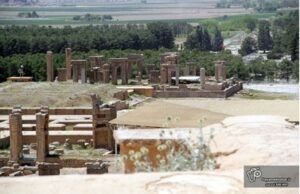

This article explores the mysteries of Persepolis, the ceremonial capital of the Achaemenid Empire and one of Iran’s most significant archaeological sites. It examines the city’s monumental palaces, ancient inscriptions, sophisticated water-management system, architectural influences and historical importance while also offering personal observations from a visit to the region.
The Mysteries of Persepolis
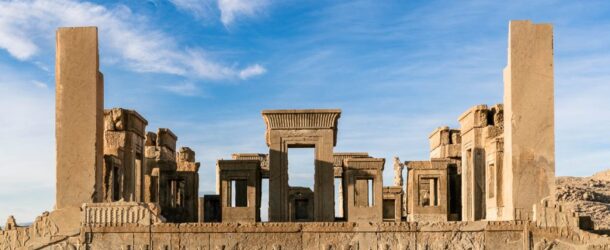
Persepolis is one of Iran’s most famous regions and historical sites. While the word Perse means Persian, polis means city. Combined, the name signifies the “City of the Persians.” This name was given to the city by the Greeks. During the Islamic period, it was referred to by names such as the “Forty Columns” or the “Thousand Columns.” Archaeologists state that Persepolis was founded by the Achaemenid king Darius I.
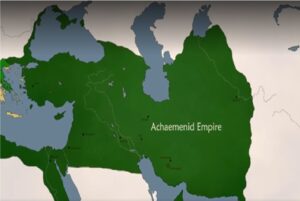
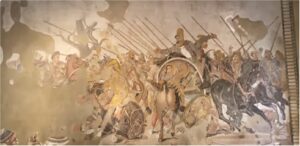
The earliest structure at the site is believed to date back to approximately 515 BCE. Before the city could be fully completed, however, it was plundered by Alexander the Great in 330 BCE. Alexander defeated the Achaemenid Empire and continued his military campaigns as far as India. During this period, Iran and the surrounding regions came under the influence of Hellenistic culture. The famous Alexander Mosaic depicts the battle between Darius and Alexander. The image below is a particularly well-known representation of this confrontation.
During my visit to Iran, the country’s irrigation systems attracted my particular attention. I was therefore surprised to learn that Persepolis also possessed sophisticated water-management systems, although I had previously considered Iran to be historically advanced in this field. For example, there was an irrigation system used to water the gardens of Imam Khomeini International University in Qazvin, and it greatly impressed me. In my subsequent readings, I learned that Iran had achieved a highly developed level of expertise in irrigation throughout its history.
It would therefore be difficult to discuss the mysteries of Persepolis without mentioning this subject. Beneath the city of Parsa are large water channels, part of which can be seen in the image below. These channels were constructed to manage rainwater and prevent possible flooding. In other words, even during that period, an effective rainwater drainage system had been established. Unfortunately, I do not think that Iran has been entirely successful in combining this historical knowledge with modern technologies today.
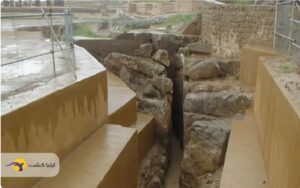
Persepolis is located near the Iranian city of Shiraz. You can travel by bus from Shiraz to the city of Marvdasht and then take a taxi to Persepolis, which is approximately 14 kilometres away. The stone used in the construction of Persepolis’s buildings and palaces was obtained from the nearby Mount Rahmat, known in Persian as Kuh-e Rahmat. Mount Hossein is located to the northwest. Marvdasht and Takht-e Jamshid—the Persian name for Persepolis—can be clearly seen on the map.
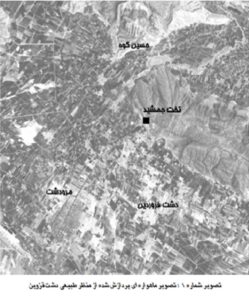
Those who can read the Persian-Arabic script may be able to identify the locations I have mentioned. The Marvdasht Plain is an area containing some of Iran’s most renowned ancient remains. Archaeological excavations have not yet been conducted throughout the entire region. Although Iranian archaeologists discover historical artefacts during these excavations, the country sometimes lacks the technological and financial resources required to examine them comprehensively. For this reason, some artefacts are sent to European countries for further study.
Let us examine the map more closely.
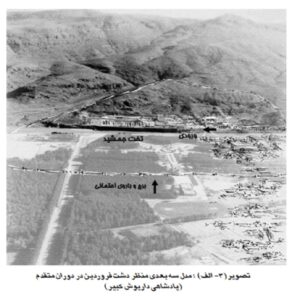
A closer photograph of this image can be seen below.
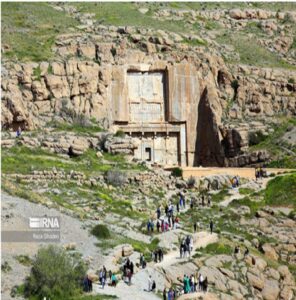
People can be seen in the image above, which also shows Mount Rahmat. The following photograph provides a more impressive view of Persepolis.
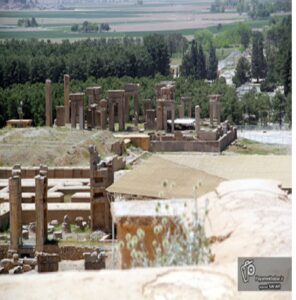
As can be observed in the image above, Persepolis consists of a complex of monumental structures. Numerous sculptures and reliefs depicting lions and eagles can also be found there. The finest stonemasons were invited to work at the site in return for payment, and even women participated in the construction process as paid workers. Many tourists are surprised when they learn that women worked at Persepolis.
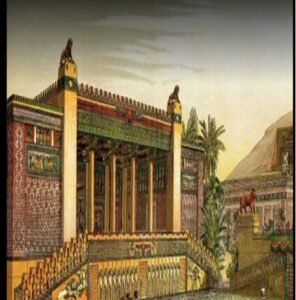
A reconstruction of the site can be seen below:
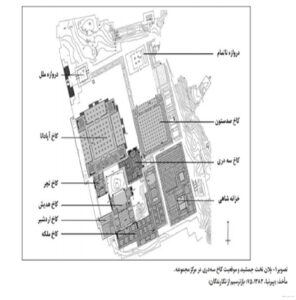
As shown here, the complex included monumental structures such as the Gate of All Nations, the Apadana Palace and the Tachara Palace. Some of these buildings have been digitally reconstructed with the help of modern technology. I invite you to examine the following images.
Western archaeologists and travellers were among the first modern visitors to arrive at Persepolis. Some of them carved their names into the stones at the site.
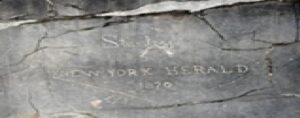
Here, we can read the name of the famous American journalist Henry Morton Stanley and a reference to the Herald. The inscription dates to as early as 1870.
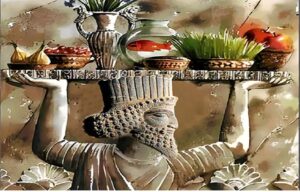
Why, then, was it considered necessary to construct Persepolis? Various theories have been proposed regarding its purpose. One of these suggests that the city was built primarily as a ceremonial centre. During Nowruz, representatives from different regions of the empire would gather there and present gifts to the king. The image below illustrates such a scene.
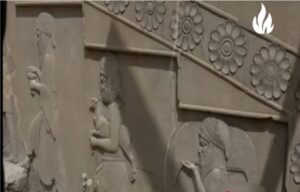
We also know that there were areas in which sacrifices were performed. This can be seen in the image below, where religious officials appear to be conducting a sacrificial ritual.
The restoration of the structures at Takht-e Jamshid took approximately eleven years. Persepolis belonged to a vast empire, and inscriptions in three languages were engraved at one of its highest points. You can examine these inscriptions below. The text reads as follows:
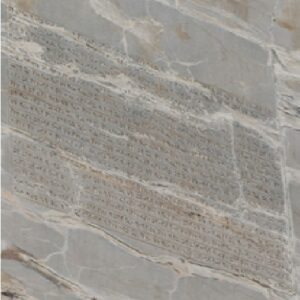
“A great god is Ahuramazda, who created this earth, who created that heaven, who created humankind, who created happiness for humankind, and who made Xerxes king: one king over many kings and one commander over many commanders.
I am Xerxes, the great king, king of kings, king of all kinds of peoples, king of this great earth extending far and wide, son of Darius, an Achaemenid.
King Xerxes says: By the favour of Ahuramazda, I built this Gate of All Nations. In addition, many other beautiful structures were built here in Persepolis—Parsa—which I built and my father built. Whatever has been constructed and appears beautiful, we built it all by the favour of Ahuramazda.
King Xerxes says: May Ahuramazda protect me, my kingdom, what I have built and what my father built. May Ahuramazda indeed protect them.”
The three languages used in the inscription are Babylonian, Elamite and Old Persian. The architecture of Persepolis was influenced by Egyptian, Babylonian, Assyrian and Greek traditions. The city was the work of three rulers—Darius the Great, Xerxes and Artaxerxes I—and was constructed over a period of approximately 188 years. It remained standing until its destruction in 330 BCE. Today, Persepolis is included on the UNESCO World Heritage List.
Mohammad Reza Shah Pahlavi, the son of Reza Shah, organised a grand celebration at Persepolis to commemorate the 2,500th anniversary of the Persian Empire. As part of the event, 2,500 trees were planted.
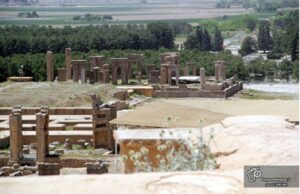
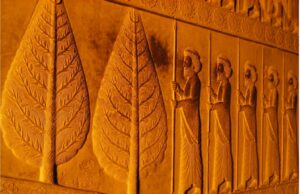
Trees can also be seen in the reliefs of Persepolis.
During my visit, I realised that travellers may encounter certain linguistic difficulties when exploring the site. Even if visitors know English or Persian, they may come across specialised historical and archaeological terms that they have never encountered before in either language. I would humbly like to draw the attention of prospective visitors to this point.
Thank you for reading.
Yorumlar
Yorum Yaz