
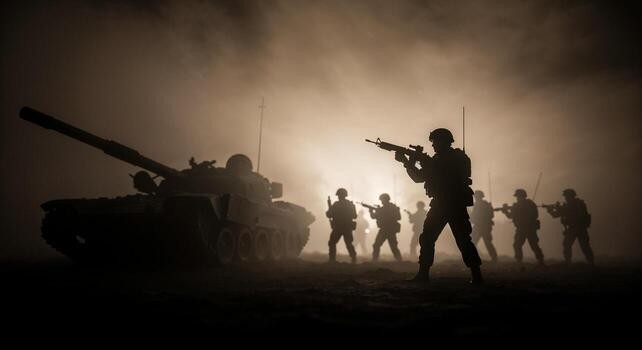

This article examines how faith and belief systems have motivated individuals and societies in warfare, from the Prophet Muhammad’s era and the Ottoman concept of ghaza to the Saudi Ikhwan movement and modern Western narratives of heroism. It argues that military power depends not only on weapons, strategy, and material interests but also on the ideals that give people the courage to risk their lives. At the same time, it emphasises that the mobilising power of religious faith should be distinguished from the moral legitimacy of actions performed in its name.
The Power of Faith to Mobilize People: War, Ghaza, and Motivation
Behind the rapid military and political achievements of certain societies throughout history lie more than military strength, population, economic resources, or political leadership. In my view, one of the most important factors that deserves attention is faith. Particularly in times of war, faith can inspire people with a degree of courage, sacrifice, and determination that would be extremely difficult to demonstrate under ordinary circumstances.
When we examine different periods of history, we encounter various examples of this phenomenon. From the understanding of jihad during the Prophet Muhammad’s time to the Ottoman conception of ghaza, and from there to the Ikhwan movement, which played a significant role in the establishment of Saudi Arabia, religious motivation appears to have exerted a profound influence on military and political movements.
The main argument I wish to put forward is this: Human beings do not fight solely for material interests. Sometimes, the greatest force that moves a person to action is the belief that the cause for which they struggle is greater than this worldly life.
Faith and Struggle During the Prophet Muhammad’s Era
One of the most significant examples of this issue can be found in the period of the Prophet Muhammad.
When we examine pre-Islamic Arabia, we encounter a politically fragmented society organised around tribes. Compared with the Byzantine and Sasanian empires of the period, it did not constitute a major political power. Mecca, meanwhile, was an important economic as well as religious centre because of the presence of the Ka‘ba. With the emergence of Islam, however, this society was presented with a much broader religious and political horizon.
One of the most important elements that the Prophet Muhammad instilled in people was a powerful faith and consciousness of the afterlife. Struggle was no longer regarded merely as an activity undertaken for the sake of tribal interests, spoils of war, or worldly gain. Concepts such as striving in the path of God, martyrdom, and reward in the hereafter profoundly influenced the psychology of Muslim combatants.
Of course, war also involved the acquisition of spoils. We may therefore speak of a structure in which material and spiritual motivations coexisted. For a Muslim, however, dying in battle did not simply mean losing one’s life. Belief in martyrdom brought with it the conviction that a far greater reward awaited beyond death.
The position of the Prophet Muhammad is particularly important in this respect. I do not believe that it would be accurate to explain his struggle solely in terms of a quest for political power, wealth, or personal fame. Historical sources relate that he lived among his Companions, led a remarkably modest life, and that visitors from outside the community were sometimes unable to distinguish him immediately from those around him.
We are therefore not speaking merely of a leader who directed people towards war, but of a prophet who himself struggled for a truth in which he believed and who gave those around him a great ideal to pursue.
Indeed, during the Prophet Muhammad’s lifetime, a substantial part of Arabia was united under Islamic political authority. Following his death, during the era of the Rightly Guided Caliphs, the conquests expanded far beyond Arabia and proceeded with extraordinary speed.
In my opinion, explaining this transformation solely through military power would be incomplete. The motivation that faith gave to people must also be taken into consideration.
The Ottoman Conception of Ghaza
A similar phenomenon can be observed during the formative period of the Ottoman state.
The Ottomans initially emerged as a small frontier principality among the numerous political entities of Anatolia. Over time, however, they first became a regional power and later developed into a vast empire.
There were many political, economic, geographical, and military factors behind the Ottoman rise. Nevertheless, I believe that the conception of ghaza, particularly during the foundation period, should not be overlooked.
Military campaigns conducted along the Byzantine frontier did more than provide the Ottomans with new territories. They also made it easier for ghazis, warriors, and various other groups in the surrounding regions to gather around the Ottoman banner. Alongside the ideal of ghaza, the distribution of spoils acquired through conquest was another factor that made the Ottomans attractive to warrior groups.
A system thus emerged in which spiritual and material motivations existed side by side.
On the one hand, there were ghaza and religious ideals; on the other, there were spoils of war and new opportunities.
The combination of these two elements became one of the factors that increased the Ottomans’ military manpower and enhanced their appeal in the frontier regions.
Religious Motivation in the Establishment of Saudi Arabia
When we turn to the modern period, we observe a similar mechanism operating under different circumstances during the establishment of Saudi Arabia.
The alliance formed in the eighteenth century between the political power of Muhammad ibn Saud and the religious movement of Muhammad ibn Abd al-Wahhab was an exceptionally important historical development. On the one hand, there was political leadership; on the other, a powerful vision of religious reform.
According to its own understanding, Wahhabism aimed to purify Islam of practices that had emerged over time and restore it to what it regarded as the purity of its earliest period. It adopted an attitude towards shrines, tombs, certain religious practices, and ornate structures that was considerably stricter than the prevailing religious outlook of the time.
Political power and religious ideals thus began to reinforce one another.
One of the most striking military consequences of this alliance was the emergence of the Ikhwan movement in the early twentieth century. The Saudi Ikhwan should not be confused with the Muslim Brotherhood, which later emerged in Egypt. The Saudi Ikhwan consisted largely of militant communities formed by settling the Bedouins of Najd and subjecting them to intensive Wahhabi religious instruction.
One of the principal sources of the Ikhwan fighters’ military strength was their powerful religious motivation.
A source I have consulted describes this situation in particularly striking terms:
“The most important factor that made the Ikhwan such a dangerous and formidable military force was the intense religious fervour of its members. Firmly believing that they would enter paradise as martyrs if they died in battle, the members of the Ikhwan could fearlessly expose themselves to every kind of danger, disregarding the risk of death or injury and motivated solely by the great reward they expected to receive.”
The source also mentions some of the slogans used by members of the Ikhwan as they went into battle:
“The scent of paradise is in the air; let everyone who longs for it hasten forward.”
Another slogan declared:
“I am the sword of divine unity, and I am the brother of everyone who submits to God.”
It is also reported that, while attacking their enemies, they loudly recited the following verse from Surah al-Fatiha:
“You alone we worship, and You alone we ask for help.”
However, it is particularly important to emphasise that the power generated by faith also had a darker side. The same source reports that Ikhwan fighters could kill women, men, elderly people, and children who stood in their path. They were reportedly unaccustomed to taking prisoners, and their attacks consequently resulted in enormous loss of life on both sides. It is further stated that their failure to pay sufficient attention to Ibn Saud’s warnings on this matter later became one of the causes of conflict between the Ikhwan and Ibn Saud.
Therefore, the fact that religious motivation can give people extraordinary fighting power does not necessarily mean that the manner in which this power is exercised is morally justified. The mobilising power of faith and the legitimacy of the actions carried out in its name are two separate matters.
An Arabia Transformed Within Decades
To understand the influence of the Ikhwan movement, it is necessary to consider the geography of Saudi Arabia.
Present-day Saudi Arabia covers approximately 2.15 million square kilometres. Given that Türkiye has an area of roughly 783,000 square kilometres, Saudi Arabia is approximately 2.7 times larger than Türkiye.
Moreover, it would be incorrect to imagine this geography simply as an “empty desert.” It contained various tribes, cities, emirates, and regional powers. Alongside the Ottoman Empire’s presence in the region, British influence was also highly significant, particularly in and around the Persian Gulf.
The House of Saud’s struggle to establish a state continued intermittently for nearly two centuries, beginning in the mid-eighteenth century. Following the First and Second Saudi States, Abdulaziz Ibn Saud embarked upon another major process of expansion in the early twentieth century. Between the capture of Riyadh in 1902 and the conquest of the Hejaz in the 1920s, political unity was established across much of the territory that constitutes present-day Saudi Arabia. In 1932, the Kingdom of Saudi Arabia was officially proclaimed.
Ikhwan fighters played extremely important military roles, particularly during certain stages of this expansion.
The point I wish to emphasise here is not that these achievements can be attributed entirely to religion. Numerous other factors were involved, including political leadership, tribal relations, regional balances of power, the weakening of the Ottoman Empire, and British policies. Nevertheless, the psychological power that faith exerted over the fighters must also be added to this list.
What Does Faith Give to a Person?
The passage concerning the Ikhwan illustrates the central idea I am trying to express particularly clearly.
When a person is told:
“If you die, everything will come to an end,”
the resulting psychological state is not the same as when that person is told:
“If you die, you will become a martyr, and an eternal reward awaits you.”
In the second case, the individual’s very relationship with death changes.
Under ordinary circumstances, one of the most fundamental impulses guiding human behaviour is the desire to survive. A powerful belief in the afterlife, however, can enable a person, under certain conditions, to place their own life in a secondary position for the sake of a cause they believe to be greater than themselves.
This is one of the principal sources of religion’s power in military struggles.
How the Modern West Creates Heroes
When we move from these historical examples to modern Western societies, I observe a different mechanism of motivation.
There is a recurring narrative in Western cinema that particularly draws my attention. At the beginning, we encounter an ordinary character—sometimes unsuccessful or regarded as insignificant by society. This character is then entrusted with an immense responsibility:
“Everyone is in danger, and you are the only person who can stop it.”
In this way, an ordinary individual suddenly becomes part of a great cause.
By the end of the film, that ordinary person has been transformed into a hero.
Here, a different world of meaning is constructed in place of explicitly religious motivation: the homeland, humanity, freedom, family, society, duty, or the idea of saving the world.
Christianity, belief in the afterlife, and religious motivation have certainly not disappeared entirely from Western societies. However, as modern states and armies have largely become secular institutions, it has become necessary to construct military motivation through different means.
Modern Western armies also place great emphasis on technologies, intelligence capabilities, defence systems, and risk-reduction methods designed to protect soldiers’ lives. The substantial investments made by the United States in military defence, early-warning systems, intelligence, and personnel safety may be regarded as one example of this approach.
Two different psychological frameworks emerge here.
The first states:
“Do not fear death; a greater reward awaits you after death.”
The second states:
“Fulfil your duty, but take every possible precaution to remain alive.”
Historical reality, of course, cannot be reduced to two such simple categories. It would be incorrect to conclude that Muslim armies lacked caution and strategy, just as it would be wrong to claim that Western soldiers have not demonstrated great acts of sacrifice. Nevertheless, the fact that societies employ different sources of motivation when preparing people for war is an important issue that deserves careful consideration.
Conclusion: Human Beings First Fight in Their Minds
When we examine different examples—from the era of the Prophet Muhammad to the Ottomans, from the Ottomans to the Saudi Ikhwan, and from there to modern Western societies—we encounter a common principle:
Providing people with weapons is not enough to mobilise them; they must also be given a meaning or cause for which they are willing to struggle.
A weapon can increase the physical power available to a person. Yet what enables someone to risk their life in order to use that weapon is often the belief held within their mind.
During the era of the Prophet Muhammad, this meaning was shaped by faith in God, jihad, martyrdom, and belief in the afterlife. During the formative period of the Ottoman state, the conception of ghaza became an important source of motivation. In the establishment of Saudi Arabia, Wahhabi doctrine—and particularly the intense religious motivation of the Ikhwan fighters—played a notable role. Modern secular societies, meanwhile, seek to generate similar forms of motivation through concepts such as the homeland, freedom, heroism, duty, and the protection of society.
For this reason, it is not sufficient to interpret military history solely through the size of armies, the quality of weapons, or the strategies of commanders.
We must also understand what an army believes in.
For sometimes the greatest power on the battlefield is not the weapon in a person’s hand, but their belief in why they are carrying it.
Ozan Dur




Yorumlar
Yorum Yaz