
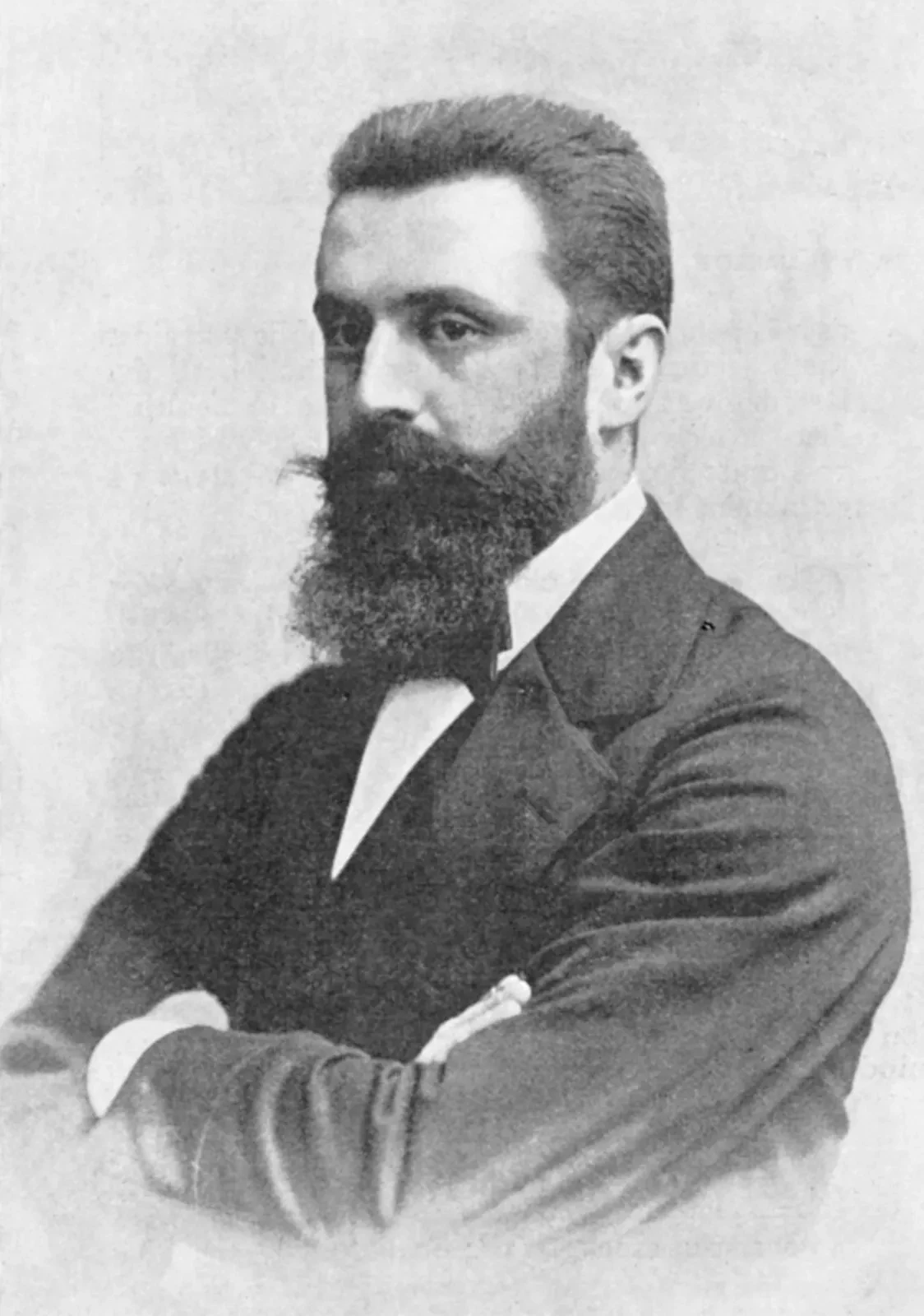

This article examines the historical development of Zionism through the Jewish doctrine of the Three Oaths, the Haskalah, European nationalism, secularism, antisemitism, and the transformation from a passive longing for Zion into an organised political movement. It also discusses the roles of Napoleon, Rabbi Kalischer, Naftali Herz Imber, Theodor Herzl, European imperial powers, and Eastern European pogroms in shaping modern Zionist thought and facilitating the eventual establishment of Israel.
Zionism’s Violation of the Three Oaths and Its Historical Development
Zionism essentially represents a departure from a long-established Jewish tradition. According to this interpretation, Zionism succeeded as a result of the violation of the Three Oaths made before God. I would therefore like to begin this discussion of Zionism by examining these three injunctions.
The First Oath
שלא יעלו ישראל בחומה
She-lo ya’alu Yisrael be-homah means that the people of Israel should not immigrate collectively to the Land of Israel by force. It may also be understood as an injunction against the Jewish people ascending to the Land of Israel en masse or through the use of force.
The second oath states that Israel should not rebel against the other nations. Its Hebrew formulation is as follows:
השביע הקב״ה את ישראל שלא ימרדו באומות העולם
Hishbia Ha-Kadosh Barukh Hu et Yisrael she-lo yimredu be-umot ha-olam.
“God made Israel swear that they would not rebel against the nations of the world.”
It has been argued that this oath encouraged Jews to remain politically passive. The reluctance of some Jews to rebel even when Hitler began systematically persecuting and murdering them has also been associated with this oath. Furthermore, certain religious Jews maintained that the Holocaust was a divine punishment brought about by the Jewish people’s violation of the Three Oaths. According to this interpretation, God had warned that the Jews would suffer a devastating massacre if these oaths were broken.
As Özgür Dikmen has also pointed out, the Holocaust subsequently provided a major source of legitimacy for the establishment of Israel. Had the Holocaust not occurred, it would have been far more difficult for the Zionist movement to seize the land of the Palestinians—a people inhabiting a land rather than, as the Zionist slogan suggested, “a land without a people”—and to secure European legitimacy and support for this project. At that time, two principal global powers existed, and both were European. In this respect, obtaining European recognition was extremely important then and, to a certain extent, continues to retain its significance today.
“The Gemara states that if Israel violates these oaths, their flesh will be left unprotected like the wild animals of the field; that is, Hashem will bring tremendous suffering and physical destruction upon them.”
Consequently, a considerable number of religious Jews interpreted the events in this way.
The Third Oath
The third oath is expressed as follows:
השביע הקב״ה את עובדי הכוכבים שלא ישתעבדו בישראל יותר מדי
Hishbia Ha-Kadosh Barukh Hu et ovdei ha-kokhavim she-lo yishtabedu be-Yisrael yoter midai.
Here, God makes the non-Jewish nations swear that they will not oppress the Jewish people excessively. A more literal translation is:
“God made the worshippers of the stars—the nations—swear that they would not subject Israel to excessive servitude.”
Two of these Three Oaths directly concern the conduct of the Jews. According to this interpretation, the Jewish people violated both: they migrated collectively to Palestine and rebelled against the nations. Some religious Jews therefore believed that God punished the Jewish people by subjecting them to the Holocaust.
Napoleon: The Messiah Before the Messiah
Napoleon succeeded in promoting the principles of liberty, fraternity, and equality in his own country and sought to spread these ideas to other lands. Within this framework, Jews and other religious minorities were granted equal rights. Napoleon believed that faith was among the most sacred aspects of human life, and he consequently recognised a degree of religious freedom.
The Jews therefore gave him the epithet “Cyrus.” Cyrus had liberated the Jews from oppression and permitted them to rebuild the Temple. Similarly, while attempting to capture Acre, Napoleon issued a proclamation to the Jews. He proposed restoring the Temple of Solomon in Jerusalem on their behalf. When this objective could not be realised, he metaphorically invited them to rebuild their temple in France.
The Jews were greatly surprised by the transformation they experienced. They were even permitted to attend universities. When Napoleon was later asked why he had granted the Jews so many rights, he reportedly explained that they were wealthy and that their wealth could be brought to France.
In this respect, Napoleon may be regarded as one of the earliest proponents of ideas resembling Zionism. At an early stage, he recognised that the Jews could become an important political instrument. Napoleon also reconvened the Sanhedrin, which had not assembled for more than 1,800 years. During this gathering, Jewish religious leaders came together to discuss the principal issues facing their communities.
In return for the rights granted by Napoleon, Jews recited the following prayer in synagogues throughout the territories under French rule:
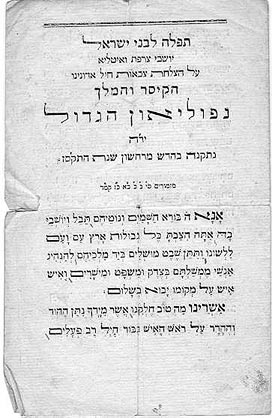
“O Creator of the Heavens, the Universe, and every living being within it! We implore You. You established all the boundaries upon the earth and the languages unique to every nation. You placed the sceptre of power in the hands of kings so that they might govern peoples with justice, righteousness, and integrity, and so that every person might live peacefully in his own place.
How fortunate we are, and how beautiful is our destiny, that glory and splendour have been bestowed by Your hand upon a mighty man—the exalted NAPOLEON, filled with vitality. Who else can be found like this man, seated upon the thrones of France and Italy, deserving of such honour and sovereignty? He guides his people with sincerity and with the understanding of his heart. You, O MOST HIGH GOD, have granted him Your extraordinary mercy. When other kings came to wage war against him, You protected him on the day of battle and delivered him from those who rose against him, until he subdued them and they sought peace in his presence. With his gentle spirit, he spoke words of peace to them.
Kings have now united, broken their treaties, and brought the bloodshed of war in place of peace. They have assembled armies to fight against him and all those who love him. They have reached our borders, and our lord, our Emperor and King, has confronted them with the power of his army.
O MOST HIGH GOD, Possessor of majesty, strength, power, and beauty! We implore You: Stand beside his righteousness; assist him and support him with Your mighty arm. Protect him as the apple of Your eye and grant him abundant strength and health. Deliver him from every evil and say to him: ‘I am your salvation.’
Send forth Your light and truth so that they may guide him. Confound those who rise against him with evil intentions. Cast Your light upon their plans. Strengthen his armies and the armies of his allies.
May he succeed in all his undertakings and prevail over his enemies. May they seek peace from him, for he is a lover of peace and will establish peace among his people.
O Father of Mercy and Lord of Peace! Place thoughts of peace and tranquillity for the benefit of humanity into the hearts of all kings and their counsellors. May the sword not pass through our land and spill the blood of our brethren. May all nations unite forever in complete peace and tranquillity. Amen.”
Through these words, the Jews expressed their gratitude to Napoleon. Although Napoleon reportedly proposed the establishment of a Jewish state in Palestine, the Jews did not accept the proposal at that time. Circumstances subsequently turned against Napoleon because he failed to capture Acre. He was halted there by Jazzar Ahmed Pasha.
The original prayer reproduced above is approximately twice as long, but I considered it appropriate to include only part of it here. Further details may be found on the relevant website.
The Haskalah and the Transformation of Jewish Thought
With the emergence of the Haskalah, or Jewish Enlightenment, the influence of traditional Jewish religious thought began to weaken. Many Jews abandoned or distanced themselves from their religion, language, and culture, yet even this did not resolve the problems they faced. Neither Enlightenment nor emancipation fully liberated the Jews.
During this period, belief in the coming of the Messiah also weakened. This transformation occurred in an age when numerous peoples were establishing their own nation-states. As many as forty-five states gained independence by separating territories from the Ottoman Empire. Jews were naturally attentive to reports of these nationalist movements.
Britain had eventually decided to dismantle the Ottoman Empire, which had long been described as the “sick man of Europe.” Although Sultan Abdülhamid II did not wish to permit an operation upon a living body, he was ultimately unable to prevent it.
The Middle East was among the last major regions to be colonised, and the Ottoman presence delayed its colonisation. Initially, Britain was reluctant to divide the Ottoman territories because such an undertaking could provoke conflict among the European powers. This is precisely what happened: the First World War created conditions that eventually contributed to the outbreak of the Second World War.
It has been argued that the injustices committed after the First World War and the humiliation imposed upon Germany played a considerable role in this outcome. For this reason, the post-war settlement has been described as “the peace to end all peace.” E. H. Carr referred to the period as the “Twenty Years’ Crisis,” an era characterised by profound disorder and turmoil. His book, The Twenty Years’ Crisis, 1919–1939, remains influential today. Even familiarity with the titles of these works can provide important insights into the relationship between the two world wars.
The Emergence of Zionism in Eastern Europe
Zionism first emerged in Eastern Europe. Russians frequently portrayed the Jews as responsible for poverty and social backwardness. As a result of the abundance of such accusations, Jews produced numerous books, novels, and other works centred on the theme of the scapegoat. In many countries, Jews were indeed treated as convenient scapegoats.
Following the assassination of the Russian tsar, Jews were accused of regicide, and pogroms against them intensified. However, it should be remembered that the Russian authorities also persecuted numerous other ethnic communities, including Armenians, Azerbaijanis, and Ahıska Turks. Severe campaigns of oppression were conducted under the policy of Russification. Pogroms and state violence were therefore not directed exclusively against Jews; many non-Jewish groups also suffered under Russian rule.
While escaping these pogroms, many Jews preferred North America, which they regarded as a land of freedom. The West, meanwhile, sought to resolve its own “Jewish Question” by supporting the creation of a Jewish state in Palestine. The Eastern Question resulted in the dismemberment of the Ottoman Empire, while the Jewish Question eventually resulted in the allocation of a homeland to the Jews in the heart of the Islamic world.
Those who migrated to North America entered a comparatively comfortable environment. The economic strength and prosperity of the United States were rapidly increasing. By contrast, the pioneers known as the Hehalutz encountered serious difficulties in Palestine. Their lack of agricultural knowledge, the presence of marshlands, malaria, and inadequate living conditions created severe hardships. Some were unable to endure these conditions and returned to North America.
A considerable proportion of those who went to Palestine consisted of individuals who could not afford to migrate to the United States, since travelling to America required financial resources. Zionist organisations continually attempted to transport Jews to Palestine by ship and to obtain the necessary funding. Many desperate Jews therefore felt compelled to migrate to Palestine. In my opinion, had they possessed better alternatives, a significant number would not have chosen Palestine.
Even Theodor Herzl, after observing Jerusalem and its deeply religious atmosphere, concluded that European Jews might not be able to live there and consequently supported the Uganda proposal as a possible Jewish homeland.
From Passive Longing to Active Zionism
The Jewish ideal of returning to Zion had traditionally been passive. One of the principal reasons for this passivity was the belief that collective migration to the Holy Land was forbidden before the arrival of the Messiah, alongside the oath prohibiting rebellion against the nations.
Nevertheless, Jews prayed every year during Passover: “Next year in Jerusalem.” In 1878, Naftali Herz Imber wrote Hatikvah—“The Hope”—which would later become the Jewish national anthem. Its final lines declared:
לִחְיוֹת עַם חוֹפְשִׁי בְּאַרְצֵנוּ
אֶרֶץ צִיּוֹן וִירוּשָׁלַיִם
Lihyot am hofshi be-artzenu,
Eretz Tzion vi-Yerushalayim.
“To live as a free people in our own land,
The land of Zion and Jerusalem.”
At the First Zionist Congress held in Basel in 1897, Hatikvah was adopted as the anthem of the Zionist movement. In 1948, it became the national anthem of Israel. Herz Imber occupies an important place in Zionist historiography and, in my opinion, deserves further scholarly attention. I hope that young researchers will undertake studies of his life and works. Even before the state had been established, Zionism already possessed an anthem.
Zionists had remained passive during the Napoleonic era, but they eventually became unwilling to continue in this position. The necessary historical and political conditions were gradually emerging. Seda Özalkan identifies four principal factors that contributed to the rise of Zionism:
-
The continued absence of the Messiah
-
The rise of nationalism in Europe
-
The influence of secularism
-
The growth of antisemitism
These factors contributed collectively to the emergence of Zionism and also influenced one another. The rise of secularism, for example, weakened traditional expectations concerning the Messiah. The appearance and subsequent failure of false messiahs also left Jewish communities disappointed.
Antisemitism demonstrated that Jews could not necessarily find permanent security in Europe and encouraged the belief that establishing a Jewish state had become necessary. Nationalism, meanwhile, represented the Zeitgeist, or spirit of the age. Together, these developments laid the foundations of Zionism as a form of Jewish nationalism.
During the transition from passive Zionism to active Zionism, Jews were also influenced by Christian political and theological movements. Certain Christian groups had their own plans concerning the Jewish people, while Jewish activists increasingly felt the need to adopt forms of direct political action similar to those employed by Christians.
Kalischer and the Early Foundations of Active Zionism
The first person to argue explicitly that Palestine should be colonised and that the Jews should no longer wait passively for the Messiah expressed this view in 1843. He was Rabbi Kalischer of Posen and Thorn, who presented these ideas in a book entitled Sefer Emunah Yesharah.
As can be understood, Kalischer was a rabbi who moved beyond the dominant religious interpretation of his time. As previously discussed, traditional Judaism prohibited collective migration to Jerusalem before the coming of the Messiah. Kalischer departed from this position and, at a remarkably early date, contributed to the intellectual foundations of Zionism. His book consequently secured him a place in history.
It should be remembered that the earliest intellectual pioneers of Zionism were not highly influential and failed to attract large numbers of followers. At the same time, the religious expectation of passively awaiting the Messiah gradually lost its persuasive power, and discursive authority increasingly passed into the hands of secular thinkers.
With Herzl, however, the Zionist movement acquired considerable momentum. Secular Zionist discourse did not remain merely theoretical but was transformed into political action. Zionism gained strength partly because major powers such as Britain and France viewed it sympathetically and wished to resolve what they called the “Jewish Question.”
Herzl himself believed that a Jewish state in Palestine had to be established through diplomacy and with the assistance of the great powers, and he devoted considerable effort to this objective. From this perspective, the establishment of the state required the abandonment of a Jewish religious tradition extending over approximately three thousand years.
That tradition had enabled Jewish communities to survive, remain attached to their heritage, and resist complete assimilation. Today, however, Western values have penetrated Israeli society, just as they have penetrated many other societies around the world.
Ozan Dur



Yorumlar
Yorum Yaz