
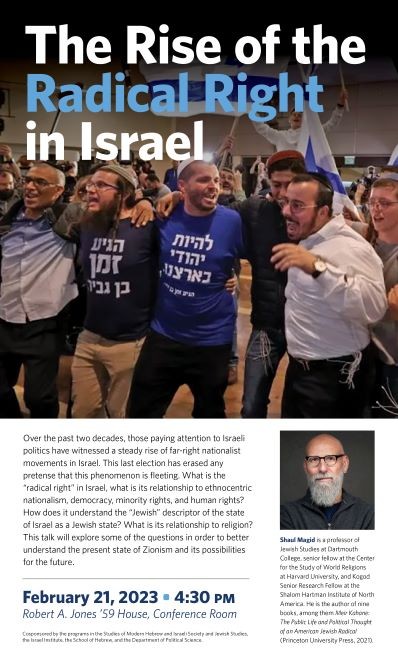

Roots of Radicalism in Israel
The Foundations of Radicalism in Israel and Its Contemporary Reflections
The Turkish Language Association defines radicalism as “fundamentalism” or “rooted extremism.” Israel Shahak, meanwhile, used the expression Jewish Fundamentalism in the title of his well-known work. We can also observe that some policymakers and analysts use similar terminology.
However, modern academic studies of radicalization gained particular momentum in the West and the United States after the attacks on the Twin Towers.
From that point onward, research focused heavily on what was described as “Islamic radicalism.”
The radicalization of evangelical movements and Jewish religious-nationalist groups received comparatively less attention.
The emergence of ISIS, together with the political upheavals associated with the Arab Spring, further reinforced this academic and political focus.
This article instead examines the radicalization of certain Jewish and Israeli political currents and seeks to explore some of their historical roots.
Zionism and the Early Political Foundations
If we wish to speak specifically about the State of Israel, it may be appropriate to begin in 1948.
However, Zionism—the ideology that played the central role in the establishment of Israel—entered global politics much earlier, particularly from the nineteenth century onward.
It can be argued that certain forms of Zionism possessed radical characteristics from an early stage.
The political transformation of Zionism was especially significant because once Zionism moved from cultural and religious aspiration into organized political activity, regional tensions became much more serious.
From Theodor Herzl’s memoirs and diaries, we know that he sought agreements with the major powers of his time.
He approached each great power with proposals designed to appeal to that state’s particular interests.
When dealing with Western powers, he presented the Zionist project in ways that could be compatible with their imperial and colonial ambitions.
Whenever a political project enters a region through the framework of imperial expansion, resistance from the existing population naturally becomes possible.
Zionism also developed during the same historical period in which Arab nationalism was emerging.
Under these conditions, confrontation increasingly became difficult to avoid.
From the Haskalah to Secular Zionism
Following Moses Mendelssohn and the Haskalah, Jewish political thought increasingly moved beyond a purely religious framework.
Had many European Jews remained exclusively within traditional Orthodox structures, they might not have achieved the same level of worldly and political organization that later characterized the Zionist movement.
Zionism emerged in large part as a secular, socialist, and nationalist movement.
Its supporters established communal agricultural settlements known as kibbutzim.
These settlements became part of the developing Jewish community in Palestine, known as the Yishuv.
In the field of security, organizations such as HaShomer, meaning “the Guard,” were established as some of the earliest organized Jewish defence formations.
Herzl argued that Arab communities would eventually recognize the economic prosperity brought by Jewish settlement and would therefore have little reason to oppose Zionism.
This raises an important question:
If conflict was not expected, why was there such an early need to create organized defence forces?
One answer lies in the economic and social transformation taking place on the ground.
As Jewish settlements expanded, Zionist labour policies increasingly attempted to replace Arab labour with Jewish labour.
The campaign for the “conquest of labour” sought to ensure that Jewish-owned farms and institutions employed Jewish workers.
This naturally created economic tensions and contributed to conflict.
The roots of the confrontation were therefore not purely religious.
As is often the case with wars later described in religious terms, material and political factors were also highly important.
Control over land, agricultural territory, political power, and water resources became central areas of competition.
Armed Zionist Organizations and Political Violence
Many of the founding Zionist elites were secular Ashkenazi Jews.
They had been educated in Europe and sought to create an Israel closely connected to Western political and cultural models.
During the struggle for statehood, armed organizations such as the Haganah, Irgun, Lehi—also known as the Stern Group—and Palmach emerged.
Some of these groups carried out acts that were regarded by the British authorities and others as terrorism.
Among the most famous were the bombing of the King David Hotel, in which more than ninety people were killed, and the massacre at Deir Yassin.
The King David Hotel bombing contributed to the worsening British security situation in Palestine, while the events at Deir Yassin intensified fear among Palestinian communities and contributed to population flight.
Vladimir Jabotinsky’s political vision also included the idea of an “Iron Wall.”
According to this approach, Zionism had to establish such overwhelming strength that Arab resistance would eventually become ineffective.
In its harsher interpretations, this strategy became associated with removing Arab resistance and ensuring that displaced populations could not easily reverse Zionist territorial gains.
From Underground Militancy to State Leadership
The continuation of political violence by underground armed organizations represents, from a legal perspective, a violation of civilian rights and public order.
However, after the establishment of Israel, a number of figures associated with such underground movements were later integrated into the political system and even celebrated.
Menachem Begin, Yitzhak Shamir, and several other former underground activists eventually reached senior positions within the Israeli state.
This meant that individuals associated with violent pre-state organizations were not necessarily excluded from political legitimacy after 1948.
The author argues that this experience may have influenced the political culture of the new state.
According to this interpretation, a pattern emerged in which members of the security establishment were often strongly protected by state institutions even when serious accusations were made against them.
The author further suggests that the limited accountability sometimes seen in later military operations may have historical roots in this early political culture.
This is, however, an interpretive argument rather than an uncontested historical conclusion.
The Rise of Religious Zionism After 1967
The early Zionist movement was predominantly secular.
Yet after the 1967 war, religious Zionism became increasingly politicized.
This transformation was particularly significant because political organization gives ideological movements access to state institutions, financial resources, and legislative power.
For this reason, when extremist religious movements succeed in entering parliament and gaining influence within the Knesset, their ideas become much more consequential.
The 1967 war was interpreted by many religious Zionists as a nes—נס—meaning a miracle.
Israel dramatically expanded the territories under its control and gained access to sites of enormous religious importance.
This period can therefore be seen as one of the decisive moments in the rise of religious Zionism.
Rabbi Abraham Isaac Kook had been one of the important intellectual figures in religious Zionist thought.
Yet whether he could have imagined the later development of this movement into a powerful political bloc is another question.
For that transformation, another highly influential figure would emerge:
Rabbi Meir Kahane.
Meir Kahane and the Religious Roots of Radicalism
The religious and political roots of some contemporary forms of Jewish radicalism can be examined through the ideology of Rabbi Meir Kahane.
Kahane openly advocated the removal of Palestinians and Arabs under a variety of political conditions.
His activities in the United States, including involvement in militant organizations and controversies surrounding violent activism, eventually led him to relocate to Israel.
Once there, he continued to promote his ideology through books, speeches, and political organization.
Elements within Israeli society provided him with sufficient political space to spread his ideas.
From this period onward, sections of the Israeli right became increasingly associated with the settler movement and with the expansion of Jewish settlements in the occupied territories.
Kahane played an important role in developing this ideological current.
The 1973 War and the Politics of Settlement
The Yom Kippur War of 1973 created a profound sense of insecurity within Israeli society.
Many Israelis experienced, perhaps for the first time since 1948, a genuine fear that territorial gains and sacred sites could be lost.
This fear contributed to stronger support among certain religious-nationalist groups for permanent Jewish settlement in the occupied territories.
The logic was simple:
if Jewish civilians established permanent communities in these regions, territorial withdrawal would become politically and socially more difficult.
At the same time, Palestinians were increasingly displaced from certain areas or prevented from returning to land incorporated into expanding settlement structures.
For many years, Israeli governments supported settlement activity in varying degrees—sometimes quietly, sometimes openly.
By 2024, new settlements and settlement expansion continued to receive approval despite widespread international criticism.
The author argues that Israel has been able to pursue such policies partly because it has not faced sanctions or economic pressure comparable to those imposed by the United States and Western governments on states such as Iran.
Without serious economic or diplomatic consequences, settlement expansion may therefore continue.
In this sense, Western governments may criticize Israeli settlement activity rhetorically while still providing Israel with broader political and strategic support.
The Strength of the Religious Right Today
Religious Zionism and right-wing nationalist parties are now more politically powerful than at almost any previous period in Israeli history.
Following the coalition formed in 2022, figures such as Itamar Ben-Gvir and Bezalel Smotrich entered government through parties including Otzma Yehudit—Jewish Power—and the Religious Zionism Party.
Ben-Gvir has long been associated with political currents influenced by Kahane and has a highly controversial political past.
From the author’s perspective, the growing influence of such figures has contributed to several developments:
greater activity by Jewish religious-nationalist groups at the Temple Mount/Haram al-Sharif, increasing debate over whether Israel is moving toward a more explicitly religious state, and harsher military and security policies following 7 October.
The war in Gaza has resulted in enormous physical destruction and a very high civilian death toll.
Hospitals, mosques, schools, residential areas, and refugee camps have all been damaged or destroyed during the conflict.
The author views this destruction as one of the clearest consequences of the growing influence of radical political and religious currents.
Deterrence, Destruction, and the Begin Doctrine
Through policies associated with the Begin Doctrine, Israel increasingly adopted the principle that potential strategic threats should be destroyed before they become powerful enough to endanger the state.
This approach contributed to a political culture emphasizing deterrence and overwhelming military superiority.
However, the author argues that deterrence has often extended beyond armed organizations themselves and has affected civilian populations.
When an entire population begins to be treated as a potential security threat, the distinction between combatant and civilian becomes dangerously blurred.
Children and other civilians can then be drawn into a security framework in which they are viewed as future or potential enemies.
According to the author, such an approach represents one of the most dangerous consequences of political radicalization.
Extremist policies and appointments of radical political figures therefore create risks not only for Palestinians and Israelis but for the entire region.
Law, State Authority, and International Order
In Türkiye, when individuals face serious injustice or danger, they normally seek protection through courts, police, and state institutions.
These mechanisms are not perfect, but ideally they exist so that disputes are resolved through law rather than private violence.
The existence of functioning states also helps prevent fascism, vigilantism, and social chaos.
At the international level, disagreements between states are similarly supposed to be managed through international law, diplomacy, and institutions.
The author argues that if Western states had not treated Israel with such exceptional tolerance, the international system might today appear more consistent and just.
Territory and sovereignty are among the most fundamental rights of a state.
Yet Israel is repeatedly accused of violating the territory, water resources, airspace, and sovereignty of neighbouring peoples and states.
When such actions do not produce meaningful consequences, confidence in international law inevitably weakens.
Nevertheless, a more just international order remains possible.
The solution is not to abandon law.
It is to insist that the law be applied more consistently.
A fairer world therefore requires sustained political, legal, and intellectual effort.
Ozan Dur



Yorumlar
Yorum Yaz