
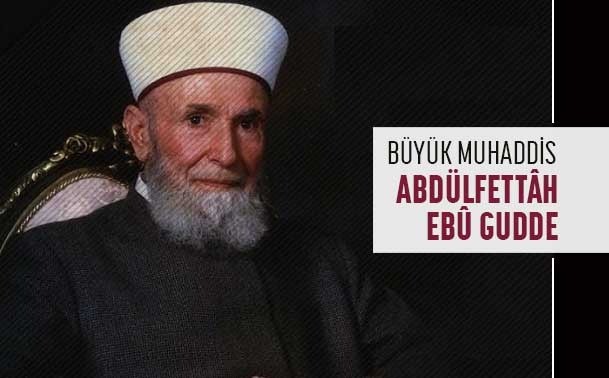

Abd al-Fattah Abu Ghuddah’s Patience on the Path of Knowledge presents inspiring examples of Muslim scholars who endured poverty, hunger, long journeys and countless hardships in pursuit of knowledge. Their lives demonstrate that genuine scholarship requires patience, sacrifice, humility and sincere devotion. The article reminds today’s students that our rich intellectual heritage reached us through the extraordinary efforts of earlier scholars and that knowledge becomes truly valuable when it is accompanied by action.
Patience on the Path of Knowledge
Miracles occurred when our Prophet (peace and blessings be upon him) was born. He was unlike other human beings. As soon as his grandfather saw him, he understood that he would become a great man. Our Prophet was a noble child from birth, and when he grew up, he became a mercy to all creation. It was as though he watered hearts that had turned into deserts with the water of al-Kawthar.
Mecca was a city of miracles. Hajar found water after striving between the hills of Safa and Marwa. Allah rewarded her effort by granting her water. Mecca was a city of miracles, and our Prophet (peace and blessings be upon him) first transformed this land, which had been a place of religious innovations, into the abode of Islam and then into a centre of knowledge.
The journey of knowledge in Islam began with the first human being, Prophet Adam. We do not know much about our father Adam’s life in Paradise, but our Lord taught him not to eat from the forbidden tree. Perhaps we may regard this as a form of beneficial knowledge. From the perspective attributed to Ali, even “a single letter” is precious and worthy of being regarded as knowledge.
It was evident—even when our Prophet (peace and blessings be upon him) was still a child—that he would grow into a great man, to put it in everyday language. When our respected teacher Abd al-Fattah Abu Ghuddah was born, his father sold a thousand pieces of cloth that day. Since Allah had granted his family such extraordinary abundance, he was named Abd al-Fattah. It was as though blessings entered our world with him. He authored nearly seventy books, many of which went through numerous editions, and, praise be to Allah, he lived a fruitful and blessed life.
Prophet Adam pursued knowledge both in Paradise and in this world. For many years, he sought forgiveness from our Lord. He wished to learn how he could be forgiven. He searched for his wife and wanted to discover how he could reach her. We may therefore say that Prophet Adam sought and valued knowledge. What he sought was not merely worldly. As the first human being, he was taught the names of things by our Lord.
We are members of the religion of Islam, whose history encompasses the very first human being. Islam is also a religion founded upon revelation and scripture. Books were given to Jews, Christians and Muslims. People were commanded to read these books and organise their lives according to their teachings. Even those who could not read were expected to listen and learn the requirements of their religion. Religions therefore contain a philosophy and present a way of life that must be understood.
The first command of our beautiful Qur’an is “Read.” Yet it says: “Read in the name of your Lord who created.” The verse speaks of “your Lord,” establishing—if I may humbly put it this way—a deeply personal and sincere form of communication with us. We have an Almighty Lord who addresses us directly as “you.” Even if He had said nothing else, if He had only addressed us as “you,” and if we could truly comprehend the kindness contained in that address, I believe we would understand how precious we are to our Lord.
The first human beings were tall. Human height gradually decreased until the time of our Prophet (peace and blessings be upon him), when it reached what we may call its ideal measure. Similarly, the Companions reached the summit of knowledge, while enthusiasm for learning gradually diminished as the centuries passed and knowledge reached us. I wished to express this as a personal reflection, and I pray that our Lord protects me from error in this comparison.
Ali (may Allah be pleased with him) is reported to have said: “I would be the servant for forty years of the one who teaches me a single letter.” Our Prophet asked some prisoners of war to teach Muslims how to read and write. He considered it appropriate for Muslims to learn even from polytheists who had come to fight against them, because he knew how valuable knowledge was and taught that wisdom was the lost property of the believer. Some of these polytheists may even have killed Muslims, yet our Prophet (peace and blessings be upon him) still approved of receiving knowledge from them. Even if some were relatives of the Muslims, we should not forget that they had come to suppress Islam. This incident may not be properly understood when considered in isolation: the Prophet first accepted ransom from the prisoners and then followed this method for those who were unable to pay it.
One of our honoured prophets, Musa, undertook a journey with Khidr. Prophet Musa wished to learn from him. He did not say, “I am a prophet; I do not need to learn anything.” Instead, he desired to travel with Khidr and benefit from his knowledge. We, too, should continue learning by always being able to say, “I do not know.” The moment we claim to know a field completely, we cease to feel the need to learn more; consequently, our knowledge becomes incomplete and outdated.
People in earlier times were extremely careful about the rights of others. It is related that one day a brick fell from a house and struck a man on the head. The owner of the house asked him: “Would you like financial compensation, or would you prefer three hundred hadiths?” Let us imagine such an incident happening to us today. In those days, among a person’s most precious possessions were the hadiths preserved in his memory and books.
People undertook scholarly journeys lasting as long as forty-five years for the sake of the words of our Prophet. Remaining in a single place to acquire knowledge was not encouraged. Students tried to study under as many teachers as possible. If these branches of knowledge have reached us today, it is because of the extraordinary, almost superhuman efforts made by our predecessors. Without their struggles, perhaps our religion’s intellectual heritage would not have survived until today.
During their journeys, scholars encountered tremendous dangers. Some were shipwrecked; some were martyred; some watched their books sink to the bottom of the sea. Books were eaten by wild animals or destroyed in floods, and many other disasters befell them. Had our forebears not made such sacrifices, we would not possess such rich fields of study today. Without the works produced by those who came before us, we cannot write even a single article. We must therefore recognise the value of our classical scholars.
One jurist was captured and forced by Bedouins to herd camels. He did not reveal his scholarly identity until the wedding ceremony of the tribal chief. Our scholars lived lives filled with tremendous trials. May our Lord be pleased with all of them. Yet this story also shows that even the Bedouins of that time recognised the value of knowledge.
Scholars studied under thousands of teachers. Even in today’s media and communication age, perhaps not even our professors can learn directly from thousands of people. In earlier times, however, there were scholars who received knowledge and authorisation from two or three thousand teachers. Today, despite all our means of communication, the number of teachers from whom we study directly barely reaches a few hundred. Abu Ghuddah describes their determination in the following words:
“They preferred crossing deserts and waterless lands, filled with desire and enthusiasm, to living a comfortable life. Whenever they drew close to the people of knowledge and the science of hadith, they regarded the hardships of travel as blessings. Wherever hadith and narrations were collected, they contented themselves with worn clothes and scraps of food. They made mosques their homes, pillars their supports and mats their beds. Casting the whole world behind them, they exchanged their food for writing, their evening conversations for listening and transmission, their rest for scholarly discussion, their perfume for ink, their nights for days, their embers for light and their pillows for stones. Wherever a higher chain of transmission could be found, every hardship they encountered seemed like comfort. Compared with failing to attain what they sought, even comfort itself became a source of distress! Their minds overflowed with the delight of the Sunnah, and their hearts were completely content with every condition in which they found themselves. Learning the Sunnah was their happiness; gatherings of knowledge were their joy; all the people of the Sunnah were their brothers, while deniers and the people of religious innovation were their opponents.”
(Abu Ghuddah, 2022, p. 105)
Acquiring knowledge was not easy for them either. One advantage they had over us was the small number of distractions surrounding them. Nevertheless, gaining knowledge in their time was extremely difficult. When they wished to support a family and marry, they often found themselves unable to do so. For this reason, many scholars of the past remained unmarried.
Today, knowledge is easy to access, but distractions are everywhere. Our scholars considered leaving their homeland so that they could escape such distractions. Perhaps few things exhaust a person as much as living far from home. Longing for one’s homeland and birthplace draws the heart back. Do those who once lived in Palestine ever forget Palestine? Certainly not. Even a place in which one has lived—or merely visited—may require more than a lifetime to forget. Once we have seen Mecca, we can never forget it. Not one lifetime, but a thousand lifetimes would be insufficient. Cities such as Istanbul, Jerusalem and Medina are similar in this regard.
Professor Fuat Sezgin said the following about Muslims’ love of knowledge:
“In the early period of Islam, the Arabs were filled with a powerful thirst for knowledge, parallel to the atmosphere of spiritual awakening and the confidence born of their victories. They therefore became passionately devoted to learning and willing to receive foreign elements.”
Their desire for knowledge was so powerful that even when they had no animals to carry them during their scholarly journeys, they travelled on foot. One difference between them and some people today was that after acquiring knowledge, they returned to their homelands. They made a special effort to enlighten their communities. When old age or other difficulties forced them to leave the demanding path of knowledge, they recited moving verses such as these:
Look now: neither my hands nor my feet obey me;
Paper and pen were my friends, yet they have abandoned me.
Letter by letter, man weaves knowledge for humanity;
When I had no pain, I could write volumes endlessly.
Know that knowledge brings joy only to the one who acts;
Knowledge without action is like the example of the donkey.
Knowledge is also its owner’s beauty and honour;
When the student acts upon it, knowledge illuminates the world.
Knowledge was always what I desired and continued to write;
Until I became an old man, nothing but skin and bone.
(p. 102)
As they walked without mounts, the following couplet became almost a guiding principle for them:
Keep walking, even if your means of transport leaves you on the road;
Know that Allah will grant your reward when you travel in His path.
It was as though they carried mountains upon their backs and crossed roads that seemed impossible to pass. Even so, they never considered their achievements sufficient. It is narrated that Ahmad ibn Hanbal once said:
“Ahmad ibn Hanbal arrived from Kufa carrying a bag filled with books. Taking hold of his hand, I asked: ‘Would it not be sufficient for a person to write thirty thousand hadiths?’ He remained silent. Then I asked: ‘What if he wrote sixty thousand?’ Again, he remained silent. When I asked: ‘What about one hundred thousand?’ he replied: ‘Then he may have learned something.’ Ahmad ibn Mani‘ further relates: We later discovered that Ahmad ibn Hanbal had written three hundred thousand hadiths from Bahz ibn Asad and Affan ibn Muslim.”
(p. 123)
While studying these hadiths, they tried never to surrender to comfort or complacency. When al-Tabarani, who narrated a great number of hadiths, was asked how he had achieved this, he replied:
“For thirty years, I slept on a mat.”
Our earlier scholars made countless sacrifices of this kind. Having read about their lives, Abu Ghuddah criticised the students of the modern age and sought refuge in Allah from their attitude. Let us read his words:
“We seek refuge in Allah from the students of this age who, at the most comfortable times—when they are rested and their minds are at their clearest—sit in cool classrooms during the summer and warm classrooms during the winter, yet impatiently wait for the bell so that they may escape from a fifty-minute lesson, racing one another out of the classroom as though fleeing from a fire or escaping the captivity of a cruel murderer!”
(p. 138)
While students behaved in this way, Abu Ghuddah continued writing his book. He states that human beings can attain the highest pleasure in life through two things: one is knowledge and the other is marriage. In Abu Ghuddah’s own words:
“All pleasures are either sensory or intellectual. The highest and ultimate level of sensory pleasure is marriage, while the ultimate point of intellectual pleasure is knowledge. Whoever attains these two aims in this world has reached the final goal.”
(p. 144)
Another subject that deserves to remain constantly in our minds is our understanding of poverty. A person may certainly be poor, but poverty may bring either positive or negative consequences. Abu Ghuddah divides poverty into two categories: negative poverty and positive poverty. Let us first read his description of negative poverty and then his explanation of positive poverty:
“The first is the condition in which the mind becomes overwhelmed by the affliction of poverty that clings to a person and leaves him unable to breathe, bringing grief and sorrow, numerous dependants and a broken heart. Let us call this, as it has been described, negative poverty. Such poverty scatters the mind, kills intelligence and causes the sufferer to wither like a green tree deprived of water. This is the kind of poverty mentioned by Imam al-Shafi‘i. The poverty that befell Ibrahim al-Nazzam, as will be discussed later, was of the same kind.”
“The second is the condition of a person who is poor but whose hardship is light and who is sincerely attached to Allah. Poverty affects him only in outward appearance and clothing, while his thoughts remain orderly, bright, steady and focused. Let us call this, as it has been described, positive poverty. For a student of knowledge who is still at the beginning of life, this is a blessing, because the world cannot draw him toward its distractions and attractions. Undoubtedly, taking little from the world strengthens one’s ability to retain knowledge and reinforces one’s studies.”
(p. 150)
Ibrahim ibn Adham also recited the following couplet:
Whenever hunger came, I built a barrier before it;
I knew nothing of variety and was content with a single meal.
(p. 151)
Some students of knowledge experienced such severe poverty that they could find nothing to eat except discarded lettuce leaves. Yet they devoted everything they possessed so that knowledge could reach us and so that they themselves might deepen their understanding. Let us listen to a few stories about them:
“Regarding Baqi ibn Makhlad, it is related that he travelled across the world on foot. Al-Dhahabi narrates that Baqi would say: ‘I know a man who, during his years as a student, would sometimes pass several days without finding anything to eat except discarded lettuce leaves.’ It is also reported that on one occasion he said to his students: ‘Are you really seekers of knowledge? Is this how knowledge is pursued? Whenever you have nothing else to do, each one of you says, “I am studying knowledge and listening to hadith.” I know a man’—meaning himself—‘who, while seeking knowledge, would spend days with nothing to eat except the lettuce leaves people had thrown away. I also know a man who sold his trousers several times in order to buy paper. In the end, Allah raised him from the condition he had left behind to a high scholarly rank.’”
“It is also related that Abu Hatim Muhammad ibn Idris al-Razi, whom we mentioned earlier, said: ‘In the year 214 AH, I remained in Basra for eight months. I wished to stay there for an entire year, but my money ran out. I gradually began selling my clothes. Eventually, I was left without any money at all. Then I accompanied a friend as we visited teachers, and we listened to hadith from them until evening. When my friend departed, I returned to an entirely empty house and began drinking water because of my hunger!’”
(p. 185)
Everything written here concerns our forebears. If one day we are to speak about ourselves, we cannot give a complete account without mentioning Allah, who created us; our parents, who brought us into this world; and the scholars whose books we read along the path of knowledge.
Ali is reported to have said: “The true orphan is not the one who has lost his parents, but the one who lacks intellect and good character.” Although I am hardly qualified to do so, I would like to adapt this beautiful saying in the following way: The true orphans are the orphans of knowledge. Many of our forebears preserved knowledge and ensured its continuity, yet we have allowed that knowledge to die and have consequently made orphans of ourselves. For the death of a scholar is like the death of an entire world.
If you are going to speak of hadith and knowledge,
Begin your words with your forefathers and those from whom you descended.



Yorumlar
Yorum Yaz