
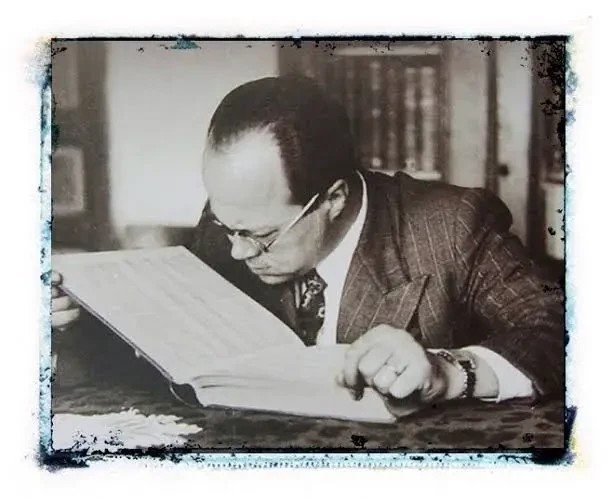

Cemil Meriç was one of the most distinctive intellectual figures of modern Türkiye, known for his extraordinary reading culture, command of French, engagement with Western and Eastern thought, and lifelong search for truth. Through works such as Bu Ülke, he introduced Turkish readers to numerous European thinkers while also exploring India, Islamic civilization, language, modernization and the complex relationship between East and West. This article examines Meriç as a “warrior of ideas,” explores his intellectual transformations and cultural criticism, and proposes new projects that could help younger generations better understand his remarkable intellectual legacy.
Cemil Meriç: A Warrior of Ideas
Cemil Meriç was born in Hatay in 1916. He witnessed the years when Hatay was under French rule. Having received his early education within the French educational system, Meriç learned French at a young age. Intellectuals, in one way or another, have almost always had something to say about learning foreign languages. Cemil Meriç was no exception. He did not remain indifferent to the question of language learning and addressed the subject in his famous work Bu Ülke (This Country). In addition to French, he also knew English and Arabic. His family had migrated from Greece following the Balkan Wars.
Cemil Meriç introduced Turkish readers to many European intellectuals and thinkers. So many foreign names appear in his books that I believe there are very few works of this kind in Türkiye. It is rare to encounter an intellectual who knew and followed Western thought as closely as he did. I wonder how many intellectuals today have read all the writers and books that Meriç refers to in his works. During his lifetime, French was largely known among educated and intellectual circles. For ordinary readers, therefore, fully benefiting from Bu Ülke was not always easy. Even among intellectuals, it would be difficult to imagine that everyone possessed such a broad range of reading and knowledge.
Cemil Meriç was always in search of truth and remained open to different ideas. There were periods when he was influenced by socialism, periods when he embraced Turkish nationalism, and periods when Islamic sensitivities became more prominent in his thought. Throughout these intellectual transformations, however, he never abandoned his pursuit of truth. He defended what he believed with determination and endured many difficulties because of his convictions. He experienced the suffering and struggle that serious thought demands. His ideas remain alive today, and his books continue to be published and read repeatedly.
Meriç closely followed the West through the French language. Yet he was by no means unaware of the East. He made an important contribution to the intellectual discovery of India in Türkiye. The West had already developed a considerable interest in India, but Meriç helped bring Indian civilization and thought into Turkish intellectual discussions. He was particularly impressed by what he saw as India’s respect for different religions and beliefs. I also believe that the mystical dimension of Indian thought did not escape his attention. Certain aspects of Indian philosophy can indeed display similarities with Sufi thought and spirituality.
Yet, according to Cemil Meriç, Türkiye had not even succeeded in truly understanding the West. Although Westernization had been on the country’s agenda for a very long time, Meriç argued that we still did not sufficiently know the thinkers and intellectual traditions that had actually shaped Western civilization.
It is difficult to find an intellectual with strong Islamic sensitivities who did not write about Sultan Abdülhamid II, especially if that person was a man of letters. Cemil Meriç also discusses Abdülhamid in his work. Sezai Karakoç similarly asks whether Abdülhamid was not justified in his suspicions. Although informing and denunciation were widespread during his reign, Abdülhamid feared being dethroned and believed that such a fate could eventually befall him. Karakoç therefore asks: Was he really wrong? History ultimately showed that Abdülhamid's fears were not entirely unfounded.
Cemil Meriç did not remain indifferent to the major intellectual debates of his time either. For example, he was not particularly sympathetic to the movement for linguistic simplification in Turkish. He argued that mecmua and dergi, although both can be translated as “magazine” or “periodical,” do not carry exactly the same spirit and cultural associations. He drew particular attention to the connection between mecmua and cemiyet—society, community and collective intellectual life. In short, he actively engaged with the issues debated by the intellectuals of his generation.
One of the most important questions addressed by Muslim intellectuals has been the question of the West. It often becomes an arena of intellectual confrontation and self-examination. I believe we can clearly observe this in Cemil Meriç as well. Thinkers and writers such as Edward Said, Sezai Karakoç, Necip Fazıl Kısakürek, Yahya Kemal Beyatlı and Cemil Meriç, despite their considerable differences, all engaged deeply with the question of the West. The West became a field of intellectual reckoning. Movements such as Büyük Doğu (“Great East”) also emerged within this broader historical and intellectual atmosphere.
From this perspective, the East was sometimes presented as superior because the West represented matter, while the East represented spirit—to borrow the language associated with Sezai Karakoç's intellectual world. Yet the degree to which the West penetrated Eastern societies was extraordinary. Traditional educational institutions such as the madrasa were weakened, while indigenous structures of knowledge, including traditions related to medicine, underwent profound transformations. The West swept across the East like a burning wind and, in many respects, left the lands it touched intellectually and institutionally impoverished.
Suggestions
We should try to realize some of the intellectual projects that Cemil Meriç was unable to complete. The projects he dreamed of undertaking in world literature and intellectual history could be continued by later generations and dedicated to his memory.
More broadly, when major writers who have become part of a society's common cultural heritage pass away, we should identify the works they hoped to produce but could not complete. Scholars and writers with the necessary expertise could then attempt to carry these projects forward. Such ambitions do not belong solely to individual authors; in a sense, they also become part of the intellectual heritage of society.
Cemil Meriç once mentioned that he had wanted for years to write a work on Balzac. Why should such a project not be reconsidered and offered to society in his memory? I would also like to see unfinished intellectual ambitions associated with Mehmet Akif Ersoy revisited. Akif, for example, had wished to write the life of the Prophet Muhammad (peace be upon him) in poetic form.
There are also countless thinkers, writers and books mentioned in Cemil Meriç's Bu Ülke. For this reason, I believe a companion book should be written to prepare readers for Bu Ülke. Without such a guide, many of Meriç's references may remain unclear to ordinary readers. This explanatory work should be written in accessible language. It could introduce the numerous figures mentioned by Meriç, briefly explain their lives and ideas, and summarize the books to which he refers. Ideally, readers could first read this introductory guide and then approach Bu Ülke with a much stronger intellectual background.
Another useful project would be to compile the books Cemil Meriç read, admired and recommended into a reading list titled something like “Books Recommended by Cemil Meriç.” Online bookstores such as Kitapyurdu could even create a dedicated “Cemil Meriç Recommendations” section. In this way, younger generations could discover the authors and books that shaped Meriç's intellectual world.
Ultimately, I recommend Bu Ülke to everyone interested in intellectual history, East-West relations, Turkish thought and the search for truth. Cemil Meriç was not merely a writer who transmitted information; he was a thinker who struggled with ideas, questioned civilizations and devoted his life to understanding both East and West.
Enjoy your reading.



Yorumlar
Yorum Yaz