
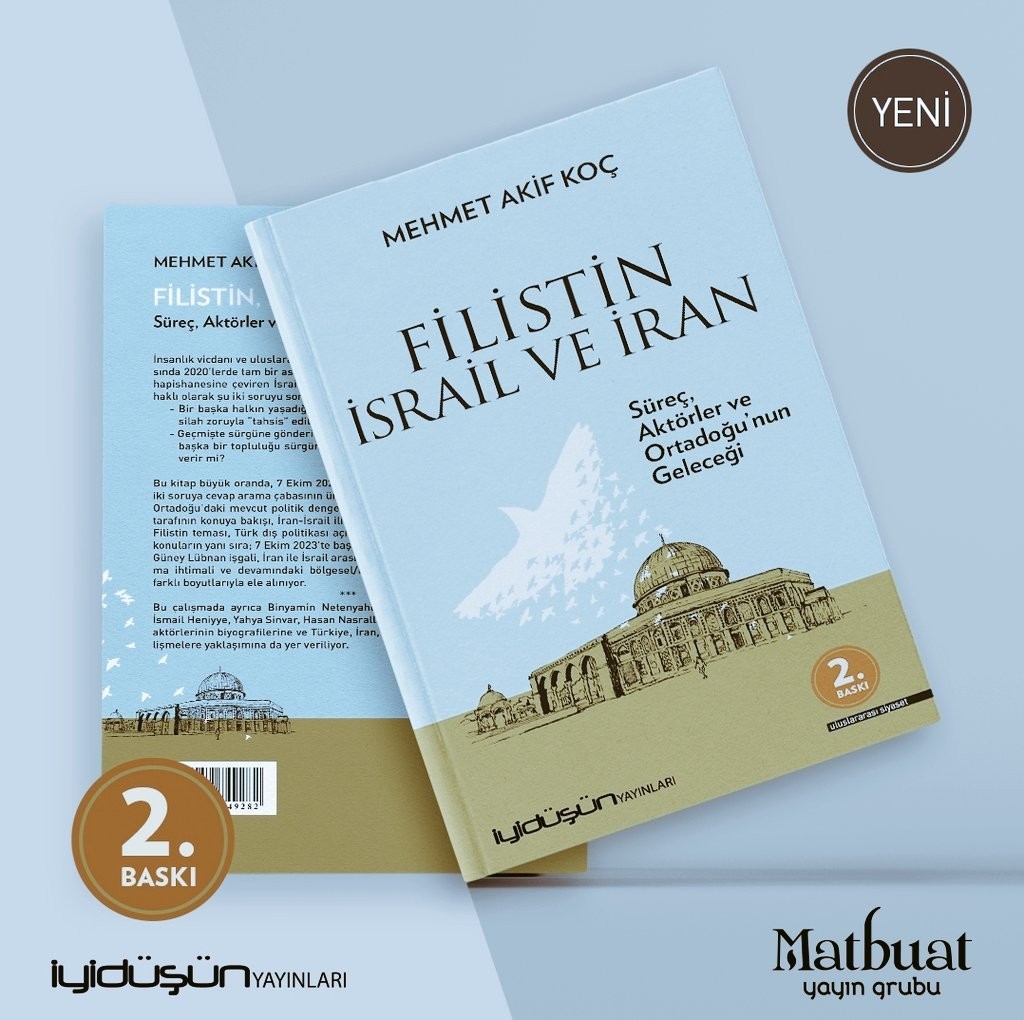

Mehmet Akif Koç’s Palestine, Israel and Iran: Processes, Actors and the Future of the Middle East offers a concise and accessible analysis of the historical background, political actors, and changing dynamics of the Middle East. Drawing on Koç’s extensive experience in the region and his knowledge of Persian, English, and Russian, the book examines the Palestine-Israel conflict, Iran’s regional role, and the transformation of the Middle East. This review discusses the book’s major arguments, its treatment of key regional actors, and concepts such as the “Gun on the Wall” and the Bedouin-Hadarî dichotomy.
Mehmet Akif Koç, born in 1982, is a graduate of Middle East Technical University (METU) and has been studying the Middle East for approximately fifteen years. Koç has an advanced command of Persian, English, and Russian. In addition to his knowledge of regional languages, he has spent a considerable amount of time in the region itself, gaining first-hand experience of the Middle Eastern context.
His book is titled Palestine, Israel and Iran: Processes, Actors and the Future of the Middle East. Published by İyi Düşün Yayınları under the umbrella of Matbuat Yayınları, the book was published in October 2024. The 170-page book is accessible to a general readership, while also offering valuable insights for those working in international relations, history, society, and Middle Eastern studies.
The articles collected in the book were previously published in outlets such as Fokus+, Yeni Arayış, and Politik Yol. At the end of the book, Koç also recommends nearly sixty books for readers who wish to pursue further reading and research on the subject.
In addition to this book, Koç has translated nine works from Persian and other languages, including Ayatollah Khomeini. He has also authored seven books, including Rekabetten: Türkiye-İran İlişkilerinin Güvenlik Boyutu (From Rivalry: The Security Dimension of Turkish-Iranian Relations). With a total of sixteen published works, Koç continues to write and translate books focusing on the Middle East.
The Long and Difficult History of Jews in Europe
The history of Jewish life in Europe was extremely difficult and painful. Jews were often prevented from working in professions of their choice, forced to live in ghettos, required to wear distinctive signs indicating their religious identity, and excluded from wider society. They were frequently treated as outsiders and portrayed as a “miserable” or undesirable community.
Jews were also turned into scapegoats for various social problems in Europe. Even major epidemics such as the plague were, at times, blamed on Jewish communities.
The Holocaust carried out by Nazi Germany under Adolf Hitler represented the culmination of centuries of antisemitism in Europe. Jews refer to the Holocaust as the Shoah, or Ha-Shoa (השואה) in Hebrew. Approximately six million Jews were murdered during the Holocaust. At the same time, it is important to remember that approximately sixty million people lost their lives during the Second World War as a whole.
Yet after such a devastating war, the historical position of Jews appears, in some respects, to have shifted in the eyes of critics of Israel—from that of a persecuted people to that of a people accused of becoming an oppressor. [1]
This leads Koç to raise a fundamental moral question: Does suffering injustice in the past give a people the right to inflict injustice upon another people?
The book formulates the question in an even more direct way:
Does having been exiled and subjected to genocide in the past give a people the right to exile another community and subject it to genocide?
Another question Koç seeks to answer is equally fundamental: By what right can a country inhabited by another people be “allocated” to another community by force of arms? [2]
Interestingly, some of the earliest Jewish visitors to Palestine did not necessarily view the situation through the simplistic framework later associated with Zionism. Jewish delegations visiting Palestine reportedly encountered a land that was already inhabited. The metaphor used in this context was striking: “The bride is beautiful, but she is already married.”
This challenges the famous Zionist slogan of “a land without a people for a people without a land.” Koç approaches these questions from several different perspectives and builds his analysis around them.
Three Stages of the Modern Middle East: Fragmentation, Polarization and Transformation
Koç begins his book with a brief but concise overview of the historical development of the Middle East.
According to Koç, the modern Middle East has passed through three major stages:
- Fragmentation
- Polarization
- Transformation
Much of the Middle East had been under Ottoman rule since 1516. Four centuries later, in 1916, the region entered what Koç describes as a period of fragmentation with the Sykes-Picot Agreement. New borders were drawn across the region, often without sufficient consideration of the region's existing social, ethnic, religious, and historical realities.
The newly shaped states subsequently became arenas of competition among great powers.
The second stage was the period of polarization. During the Cold War, the United States and the Soviet Union contributed to dividing regional states into different political camps, including monarchies and republics.
Finally, Koç identifies the Arab Spring as the beginning of a new “transformation paradigm.”
During this period, concepts such as “a Palestine without Palestinians” and the various “agreements of the century” emerged as part of attempts to reshape the political order of the region following the Arab Spring.
The Main Actors of the Middle East
One of the notable features of the book is Koç's focus on individual political actors.
He discusses figures such as Khaled Mashal, Mahmoud Abbas, Benjamin Netanyahu, Ismail Haniyeh, Yahya Sinwar, and Hassan Nasrallah. These individuals have played important roles in shaping the political landscape of the region in recent decades.
Koç also refers to Yahya Sinwar's novel Thorn and Carnation and discusses Benjamin Netanyahu's psychological and political profile.
Regarding Netanyahu, Koç presents him as:
“...a narcissistic personality, an individual sometimes inclined toward megalomania, strong and ambitious, devoted, unwilling to show his weaknesses, unwilling to admit his mistakes, using people for his own purposes, always seeking to gain in his personal relationships, disloyal in politics, lacking personal and political ethics, intolerant of criticism, and entirely focused on his own existence and success.” [4]
Whether one agrees with this characterization or not, the psychological dimension adds another layer to the book's discussion of political leadership.
Iran and the Future of the Middle East
The section on the future of the Middle East is relatively brief compared with the other sections of the book.
In his future scenarios, Koç argues that Iran has reached what he describes as its natural boundaries and has been on an upward trajectory since 2003. He asks how much longer Iran can continue its current policies, particularly after suffering damage to its deterrence capabilities and amid the increasingly delicate regional balance.
Koç also predicted that, if Donald Trump were elected, Israeli attacks would increase further. He argues that a dominant regional power comparable to figures such as Gamal Abdel Nasser or Faisal is unlikely to emerge in the near future.
According to Koç, Iran's strategic relationships with Syria and Iraq are likely to continue, although they may weaken to some extent. Such a development, he argues, should not necessarily come as a surprise.
Koç also draws attention to Turkey's position in this increasingly complicated regional environment:
“Under these circumstances, an extremely sensitive period is beginning for Turkey; while Iran's sphere of influence weakens to some extent, normalization with Syria and taking a step forward with Iraq may be possible through careful competition with Iran. However, while Iran is declining, Israel's rise and emergence as a regional superpower is not a situation Ankara would prefer. In this context, strengthening Egypt—and, to some extent, Syria through its Arab identity—and enabling it to become a balancing factor against the Gulf Arabs may be possible in the medium term and would be in Turkey's interest...” [5]
Koç therefore emphasizes that Turkey needs to act extremely carefully because of the delicate balances surrounding its regional position.
“The Gun on the Wall” and the Middle East
One of the most interesting aspects of the book is Koç's frequent use of the “Gun on the Wall” metaphor.
The concept comes from the Russian playwright Anton Chekhov. The basic idea is that if a gun is shown hanging on the wall in the first act of a play, that gun will eventually be fired in a later act.
Vladimir Putin's use of this expression in recent years also brought the metaphor back into public discussion.
Koç applies the metaphor to the Middle East: the gun has appeared on the wall, but it has not yet fired in the way many might expect.
This is a powerful metaphor for understanding the region. Weapons, military capabilities, proxy organizations, unresolved conflicts, and competing regional ambitions have accumulated over decades. The existence of these elements does not necessarily mean that a full-scale regional war is inevitable—but their presence makes the possibility of escalation impossible to ignore.
A Call for a More Human and Objective Approach
Another interesting dimension of Koç's book is his criticism of ideological approaches to the Palestine-Israel question.
He particularly challenges the Turkish left to approach the issue from a more human and objective perspective. Koç asks:
“If Deniz Gezmiş and the generation of 1968 had never existed, would the Turkish left be unable to oppose Israel?”
The question is important because it shifts the discussion away from ideological loyalties and toward a more universal moral framework.
Rather than asking which political camp one belongs to, Koç encourages the reader to ask a more basic question: What is happening to human beings, and how should we respond to injustice?
This approach is one of the book's strengths.
The Bedouin-Hadarî Dichotomy
Another concept Koç uses to interpret the Palestine-Israel conflict is the classical Bedouin-Hadarî dichotomy.
The basic idea is that settled populations gradually lose some of their martial characteristics over time. They can then become vulnerable to newly arriving, more dynamic and militarily active groups—the Bedouins.
Eventually, however, these newcomers also settle down. As they become Hadarî, or settled people, they too gradually lose their former warrior characteristics. A new Bedouin group then emerges and eventually challenges them.
In this way, the historical cycle continues.
Koç applies this sociological and historical dichotomy to the Palestine-Israel question. Whether one accepts the model completely or not, it provides an interesting framework through which to think about cycles of power, settlement, conflict, and renewal in the Middle East.
Conclusion
Palestine, Israel and Iran: Processes, Actors and the Future of the Middle East is a relatively short book, but it raises questions that are much larger than its 170 pages.
Its greatest strength is perhaps its attempt to bring together history, international relations, political analysis, regional actors, and moral questions in a way that remains accessible to the general reader.
Koç does not simply ask what happened in the Middle East. He also asks why it happened, who the principal actors are, what historical processes shaped them, and where the region might be heading.
For readers interested in Palestine, Israel, Iran, Turkey, and the wider Middle East, the book provides a useful starting point. Its nearly sixty recommended books at the end also make it particularly valuable for readers who want to continue their research.
For me, one of the most important questions raised by the book is perhaps the simplest one:
Can a people who have experienced injustice in the past ever justify inflicting injustice upon another people?
That question alone makes Koç's book worth reading and discussing.
Ozan Dur
Notes
[1] I use this expression particularly in light of what happened during the Al-Aqsa Flood. Koç approaches the issue in his book in a much more balanced and objective manner.
[2] Mehmet Akif Koç, Palestine, Israel and Iran (İyi Düşün Yayınları, 2024), p. 11.
[3] Koç argues that the Ottoman Empire was not, as is sometimes assumed, a Medinetü Fazıla—an ideal state—but that it was able to remain relatively stable within its own internal balance.
[4] Mehmet Akif Koç, Palestine, Israel and Iran (İyi Düşün Yayınları, 2024), p. 168.
[5] Mehmet Akif Koç, Palestine, Israel and Iran (İyi Düşün Yayınları, 2024), p. 121.

Yorumlar
Yorum Yaz